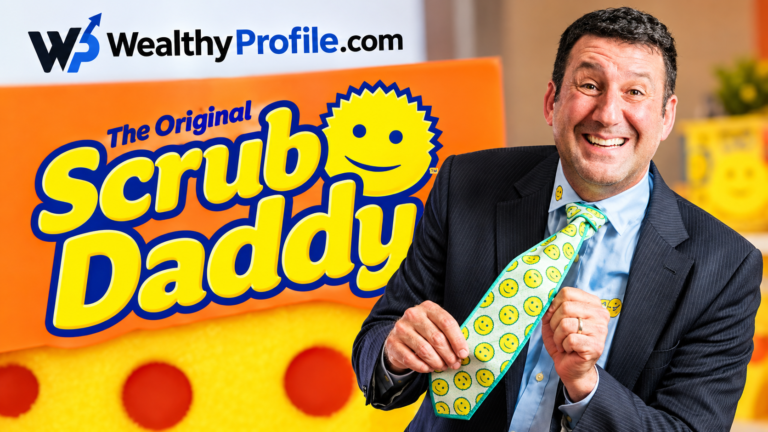
Scrub Daddy net worth in 2026 is estimated at approximately $500 million, making it the most valuable consumer product to emerge from ABC’s Shark Tank and one of the most remarkable entrepreneurial success stories in American business. That half-billion-dollar valuation belongs to a company that started with a box of sponges that 3M did not want, a founder who could not get into business school, and a $200,000 investment from Lori Greiner on a Friday night in October 2012.
The numbers behind the smiley face are staggering. Scrub Daddy generated approximately $340 million in revenue in 2024 — a 54% increase over 2023’s $220 million — and has surpassed $926 million in cumulative retail sales since its Shark Tank debut. The company now sells over 160 products across 257,000 retail locations in 47 countries, employs more than 200 people, and operates manufacturing facilities powered by solar energy in New Jersey and Tennessee. In March 2024, JPMorgan Chase was engaged to explore a potential sale or IPO, with analysts speculating that a bidding war could push the final price toward $700–$800 million.
All of this from a sponge with a smile.
In this article14 sections
- 01Quick Overview
- 02Aaron Krause
- 03The Shark Tank Deal That Changed Everything
- 04The FlexTexture Technology
- 05Revenue Growth
- 06Company Valuation Breakdown
- 07The Product Empire
- 08The TikTok and CleanTok Revolution
- 09Retail Distribution
- 10Manufacturing and Sustainability
- 11The Potential Sale
- 12Scrub Daddy vs. Other Shark Tank Success Stories
- 13Aaron Krause Net Worth 2026
- 14Frequently Asked Questions
Quick Overview — Scrub Daddy Net Worth 2026
| Category | Details |
|---|---|
| Company Name | Scrub Daddy Inc. |
| Founded | 2012 |
| Founder / CEO | Aaron Krause |
| Headquarters | Pennsauken Township, New Jersey |
| Estimated Company Valuation (2026) | ~$500 million |
| Annual Revenue (2024) | ~$340 million |
| Cumulative Retail Sales | $926 million+ |
| Shark Tank Season | Season 4, Episode 7 (October 26, 2012) |
| Shark Tank Deal | $200,000 for 20% equity (Lori Greiner) |
| Product Line | 160+ products |
| Retail Locations | 257,000+ in 47 countries |
| Employees | ~208 (as of 2025) |
| Key Investor | Lori Greiner (20% equity) |
| Aaron Krause Net Worth | $70–$200 million (estimates vary) |
| Potential Sale Status | JPMorgan Chase engaged (March 2024) |
Aaron Krause — The Inventor Who Could Not Get Into Business School
The story of Scrub Daddy begins not with a sponge but with a car wash. Aaron Krause washed cars throughout his teenage years and through his time at Syracuse University, where he graduated in 1992 with a degree in psychology — not business. He had applied to the Whitman School of Management but was not accepted, a rejection that he has since turned into one of the great punchlines of American entrepreneurship.
After graduation, Krause turned his car washing experience into a manufacturing business. He developed specialized buffing and polishing pads for the automotive industry, secured two patents, and built the company into a million-dollar enterprise. In August 2008, 3M Company acquired the buffing pad business, and Krause worked for the industrial giant for five years following the acquisition.
But there was something 3M did not want. Among the products Krause had developed was a polymer foam cleaner — a sponge-like material he had originally designed for mechanics to scrub grease and grime from their hands. 3M passed on it. The sponges sat in boxes in Krause’s factory, rejected and seemingly worthless.
Then, in 2011, came the moment that would create a half-billion-dollar company. Krause’s wife Stephanie asked him to clean their deck furniture. He grabbed one of the rejected sponges from the factory and started scrubbing. As the cool outdoor air hit the material, something happened — the sponge stiffened. When he ran warm water over it, it softened. The polymer foam changed texture based on temperature.
“The skies opened up,” Krause has said. “I realized I missed the boat. This thing had nothing to do with scrubbing your hands. It was the greatest kitchen sponge I ever used.”
He cut a smiley face into the foam — the eyes providing finger grip holes, the mouth shaped to clean utensils — and Scrub Daddy was born.
The Shark Tank Deal That Changed Everything
Season 4, Episode 7 — October 26, 2012
Aaron Krause walked into the Shark Tank on October 26, 2012, asking for $100,000 in exchange for 10% equity in Scrub Daddy. He had already tested the product at a friend’s grocery store chain, where results were extraordinary — the store was selling 200 to 300 Scrub Daddy units per day, compared to the typical 2 to 3 sponges a normal cleaning product moves.
Lori Greiner saw the opportunity. She offered $200,000 — double what Krause asked for — in exchange for 20% equity, double the stake. Krause accepted. Kevin O’Leary and Mark Cuban both passed.
The deal valued Scrub Daddy at $1 million. In 2026, that same company is worth approximately $500 million. Greiner’s $200,000 investment has grown into a stake worth an estimated $100 million — a 500x return that represents one of the most successful investments in the history of reality television.
The QVC Launch — 42,000 Units in Seven Minutes
The day after the Shark Tank episode aired, Greiner leveraged her QVC connections to get Scrub Daddy on air. What happened next entered retail legend: they sold 42,000 sponges in under seven minutes. It was the kind of product-market fit that consumer goods companies spend millions trying to engineer, and Scrub Daddy achieved it on live television with a $200,000 marketing budget and a lot of smiling foam.
Greiner subsequently helped expand distribution to major retail chains including Bed, Bath & Beyond, Walmart, Target, and Home Depot — transforming Scrub Daddy from a novelty item into a household staple within months of its television debut.
The FlexTexture Technology — Why the Sponge Actually Works
Scrub Daddy’s success is not just marketing. The product is built on genuine material science. The sponge utilizes a proprietary composition called FlexTexture — a polycaprolactone thermoplastic polyurethane foam that exhibits thermochromic properties. In plain terms, the polymer changes physical behavior based on temperature.
In cold water, the sponge becomes firm and rigid — ideal for scrubbing baked-on food, hardened grease, and tough stains. In warm water, it softens and becomes pliable — perfect for gentle cleaning of non-stick surfaces, glassware, and delicate materials. This dual functionality means one product replaces two — a hard scrubber and a soft sponge — which is both a practical advantage and a retail pricing advantage.
Aaron Krause holds two patents on the FlexTexture design. The combination of functional innovation and the iconic smiley face design created a product that was both genuinely useful and instantly recognizable — a rare combination in the commodity cleaning products market, where most items compete on price rather than differentiation.
The sponge is also odor-resistant, dries quickly, and lasts significantly longer than traditional cellulose sponges, which degrade and develop bacteria within weeks. Consumer testing consistently shows Scrub Daddy outlasting competitors by a factor of three to eight, depending on usage patterns.
Revenue Growth — From $1 Million to $340 Million
Scrub Daddy’s revenue trajectory is one of the most dramatic growth stories in consumer products history.
| Year | Revenue / Sales Milestone |
|---|---|
| 2012 (post-Shark Tank) | Over $1 million |
| 2014 | Over $18 million |
| 2016 | $75 million |
| 2017 | $150 million (total cumulative) |
| 2020 | $268 million (cumulative retail) |
| 2021 | $66.7 million (annual) |
| 2022 | $100 million (annual) |
| 2023 | $220 million (annual) |
| 2024 | $340 million (annual) |
| Cumulative Lifetime | $926 million+ in retail sales |
The growth from $66.7 million in 2021 to $340 million in 2024 represents a 410% increase in just three years — driven by product line expansion, international distribution growth, and a social media strategy that turned a cleaning sponge into a cultural phenomenon.
As of late 2025, some reports place Scrub Daddy’s cumulative retail impact at over $1.4 billion when including indirect sales channels and international distribution that is harder to track precisely.
Scrub Daddy Net Worth 2026 — Company Valuation Breakdown
The $500 million valuation assigned to Scrub Daddy in 2026 is based on analyst consensus from PitchBook and Shark Tank tracking sources, reflecting approximately a 1.5x multiple on its 2024 annual revenue of $340 million.
However, this valuation may significantly understate the company’s market value. When JPMorgan Chase was engaged in March 2024 to explore a potential sale, analysts speculated that competitive bidding from large consumer products corporations — Unilever, Procter & Gamble, and Church & Dwight among the most frequently mentioned potential acquirers — could push the final price toward $700–$800 million.
The rationale for a premium valuation rests on several factors: Scrub Daddy’s extraordinary revenue growth rate (54% year-over-year in 2024), its brand recognition and social media presence (particularly among younger consumers through TikTok), its proprietary FlexTexture technology with patent protection, and its proven ability to expand from a single product into a 160-product portfolio without diluting brand identity.
Ownership Structure
Aaron Krause retains approximately 80% ownership of Scrub Daddy Inc., making him the majority shareholder and controlling decision-maker. At the $500 million valuation, his 80% stake is worth approximately $400 million. Estimates of Krause’s personal net worth range from $70 million to $200 million, depending on the source and whether unrealized equity value is included.
Lori Greiner holds the remaining 20% equity — her original Shark Tank stake — now worth approximately $100 million on the $500 million valuation. Her initial $200,000 investment has generated a return of roughly 500x, making Scrub Daddy by far the most lucrative investment of her Shark Tank career.
The Product Empire — 160 Products and Growing
What began as a single yellow smiley-face sponge has expanded into a comprehensive cleaning product ecosystem of over 160 items. The product line strategy has been critical to Scrub Daddy’s revenue growth — each new product leverages the brand’s recognition and retail shelf space while addressing different cleaning needs.
Core Product Family
Scrub Daddy (Original): The flagship FlexTexture sponge that started it all. Available in the classic yellow and seasonal color variations, including Halloween-themed versions introduced in August 2022 that became immediate bestsellers.
Scrub Mommy: Introduced in 2014, Scrub Mommy combines the FlexTexture surface of a Scrub Daddy on one side with a traditional soft sponge on the reverse — creating a dual-sided product that became the second-best-selling item in the lineup and a standalone brand in its own right.
PowerPaste: A clay-based, non-toxic cleaning and polishing compound sold as a bundle with a Scrub Mommy sponge. Positioned as a natural alternative to chemical cleaners, PowerPaste addresses the growing consumer demand for eco-friendly cleaning products.
Damp Duster: A dust-trapping sponge designed for blinds, baseboards, and textured surfaces — one of the newer product categories that demonstrated Scrub Daddy’s ability to innovate beyond the kitchen sink.
Soap Daddy: A soap dispenser designed to complement the sponge lineup, extending the brand into kitchen and bathroom hardware.
Scour Daddy: Heavy-duty scouring pads for industrial-strength cleaning tasks.
BBQ Daddy: A grill cleaning sponge targeting the outdoor cooking market.
Scrub Daisy: A dishwand system with interchangeable cleaning heads.
Licensed and Collaborative Products
Scrub Daddy has expanded into licensed collaborations including Disney-branded Mickey and Minnie Mouse sponges — tapping into character licensing revenue and attracting collectors who purchase the products for display rather than cleaning. These limited-edition and seasonal releases create urgency and drive repeat purchasing from a consumer base that has shown remarkable brand loyalty for a cleaning product company.
The TikTok and CleanTok Revolution
Scrub Daddy’s social media strategy — particularly on TikTok — has been one of the most studied brand marketing successes of the 2020s. The company was an early mover in the “CleanTok” phenomenon, the cleaning-content subculture on TikTok where users share satisfying cleaning videos, product reviews, and home organization content.
Rather than running traditional advertising, Scrub Daddy adopted a founder-led content strategy with Aaron Krause appearing in videos that mixed product demonstrations with humor, behind-the-scenes factory footage, and irreverent brand personality. The approach resonated with TikTok’s audience, generating millions of views per video and turning a cleaning sponge into a genuinely aspirational brand among Gen Z and millennial consumers.
The TikTok strategy was not incidental to revenue growth — it was a primary driver. The company’s explosive growth from $66.7 million in 2021 to $340 million in 2024 coincides directly with its TikTok ascendance. By making cleaning content entertaining rather than transactional, Scrub Daddy reached consumers who would never have encountered the product through traditional retail marketing, and created a community of brand advocates who generate user-created content at no cost to the company.
The account has accumulated millions of followers and billions of views, making Scrub Daddy one of the most-followed consumer packaged goods brands on any social media platform — an extraordinary achievement for a product category (sponges) that had never generated cultural conversation before.
Retail Distribution — 257,000 Locations in 47 Countries
Scrub Daddy’s retail distribution network has expanded from a single friend’s grocery store chain to over 257,000 retail locations across 47 countries on five continents. The company’s major retail partners include Walmart, Target, Home Depot, Amazon, Kroger, and the QVC network that launched the brand.
International expansion has been a significant growth driver, with Scrub Daddy now available across North America, Europe, Asia, and Australia. The company operates manufacturing facilities in multiple countries to serve regional demand, and has established localized social media presences for different markets.
The Unilever distribution partnership — pairing Scrub Daddy with one of the world’s largest consumer goods companies — has accelerated international penetration, providing access to Unilever’s established retail relationships in markets where Scrub Daddy would otherwise need years to build distribution infrastructure from scratch.
Manufacturing and Sustainability
Scrub Daddy is headquartered in Pennsauken Township, New Jersey, where the company relocated to a new global headquarters designed with sustainability principles. The company operates solar-powered manufacturing facilities in New Jersey and Tennessee, reflecting a commitment to environmental responsibility that aligns with its eco-friendly product positioning (particularly the PowerPaste natural cleaner line).
The company has grown from a single product line to a complex manufacturing operation producing over 160 SKUs across multiple facilities, with quality control systems designed to maintain the FlexTexture polymer consistency that is central to the product’s differentiation.
The Potential Sale — JPMorgan, Bidding Wars, and What Comes Next
In March 2024, Scrub Daddy engaged JPMorgan Chase to explore strategic alternatives, including a potential sale or initial public offering. The announcement signaled that Aaron Krause and Lori Greiner were open to monetizing the company they had built over twelve years.
Several factors make Scrub Daddy an attractive acquisition target for major consumer goods corporations. The company has demonstrated sustained high growth rates in a mature market category (household cleaning), built a brand with genuine cultural relevance among younger consumers, developed proprietary technology with patent protection, and maintained profitability while scaling rapidly.
The most frequently mentioned potential acquirers include Procter & Gamble (which dominates the household cleaning space through brands like Mr. Clean and Swiffer), Unilever (which already has a distribution partnership with Scrub Daddy), and Church & Dwight (which owns OxiClean and other household brands). Analysts have speculated that competitive bidding could push the acquisition price to $700–$800 million — significantly above the company’s current $500 million consensus valuation.
As of mid-2026, no sale has been publicly completed. The company continues to operate independently under Krause’s leadership, and it is possible that the strong revenue growth and improving margins may encourage the founders to hold rather than sell — a decision that would depend on whether they believe the company’s growth trajectory justifies waiting for a higher valuation.
Scrub Daddy vs. Other Shark Tank Success Stories
Scrub Daddy’s position in the Shark Tank universe is formidable. As of 2024, it ranks as the third highest-revenue product in the show’s history.
| Company | Shark Tank Season | Investor | Cumulative Revenue |
|---|---|---|---|
| Bombas | Season 6 | Daymond John | $1 billion+ |
| Everlywell | Season 9 | Lori Greiner | $1 billion+ |
| Scrub Daddy | Season 4 | Lori Greiner | $926 million+ |
| Squatty Potty | Season 6 | Lori Greiner | $175 million+ |
| Tipsy Elves | Season 5 | Robert Herjavec | $125 million+ |
What distinguishes Scrub Daddy from other top Shark Tank earners is the sheer improbability of its success. Bombas operates in the large, established apparel market. Everlywell provides healthcare testing — a massive addressable market. Scrub Daddy sells sponges. The fact that a sponge company has generated nearly a billion dollars in revenue speaks to the power of genuine product innovation combined with exceptional marketing and distribution execution.
Aaron Krause Net Worth 2026
Aaron Krause’s personal net worth is difficult to pin down precisely because Scrub Daddy remains a private company and his equity has not been publicly valued through a sale or IPO. Estimates range widely.
At the conservative end, sources place Krause’s net worth at $70–$100 million, reflecting the liquidity he has likely drawn from the company over twelve years of growing profitability. At the high end, if his 80% stake in Scrub Daddy is valued at the company’s $500 million consensus valuation, his equity alone would be worth $400 million — and if a sale closes at the speculated $700–$800 million range, his pre-tax proceeds could exceed $550 million.
The practical truth lies somewhere in between. Krause is certainly worth over $100 million in liquid and semi-liquid assets, and his equity position in Scrub Daddy represents a fortune that could multiply significantly depending on the outcome of the JPMorgan-led strategic review.
His wife Stephanie serves as director of public relations for Scrub Daddy. Their daughter Sophie attends Syracuse University’s School of Education — the same institution where Krause earned his psychology degree in 1992 after being rejected from the business school. In 2023, Krause donated a $50,000 grant to the Whitman School of Management at Syracuse and created the $10,000 Scrub Daddy Jumpstart Innovation Award — a gesture that closed a circle opened three decades earlier.
He holds more than 50 patents across his career and has built or sold more than ten companies total — making Scrub Daddy not an accident but the culmination of a serial entrepreneur’s lifetime of product development and market instinct.
Scrub Daddy Net Worth — Frequently Asked Questions
What is Scrub Daddy’s net worth in 2026?
Scrub Daddy’s estimated company valuation in 2026 is approximately $500 million, based on analyst consensus from PitchBook and Shark Tank tracking sources. The company generated approximately $340 million in annual revenue in 2024 and has accumulated over $926 million in cumulative retail sales since its Shark Tank debut in October 2012. If the company is sold through the JPMorgan Chase-led process initiated in March 2024, analysts speculate the price could reach $700–$800 million.
How much revenue does Scrub Daddy generate?
Scrub Daddy generated approximately $340 million in annual revenue in 2024, a 54% increase over 2023’s $220 million. The company’s revenue growth has been explosive — from $66.7 million in 2021 to $340 million in 2024, representing a 410% increase in three years. Cumulative lifetime retail sales exceed $926 million, with some estimates placing total retail impact above $1.4 billion when including all distribution channels.
What was the Scrub Daddy Shark Tank deal?
Aaron Krause appeared on Shark Tank Season 4, Episode 7, on October 26, 2012, asking for $100,000 in exchange for 10% equity. Lori Greiner offered $200,000 for 20% equity — double the money for double the stake. Krause accepted. The deal valued Scrub Daddy at $1 million. Kevin O’Leary and Mark Cuban both passed on the investment. Greiner’s $200,000 has since grown into a stake worth approximately $100 million.
How much is Aaron Krause worth?
Aaron Krause’s personal net worth is estimated between $70 million and $200 million, depending on how his 80% equity stake in Scrub Daddy is valued. At the company’s $500 million consensus valuation, his stake alone would be worth $400 million. Before Scrub Daddy, Krause sold a buffing pad business to 3M in 2008. He holds more than 50 patents and has built or sold more than ten companies over his career.
How much has Lori Greiner made from Scrub Daddy?
Lori Greiner’s 20% equity stake in Scrub Daddy, acquired for $200,000 in 2012, is now estimated to be worth approximately $100 million based on the company’s $500 million valuation — a return of roughly 500x on her original investment. It is by far the most lucrative deal of her Shark Tank career. Greiner remains actively involved with company strategy and retail expansion, leveraging her QVC platform and retail connections.
Is Scrub Daddy the most successful Shark Tank product?
Scrub Daddy is the third highest-revenue Shark Tank product as of 2024, behind Bombas (socks, $1 billion+) and Everlywell (health testing, $1 billion+). Scrub Daddy has generated over $926 million in cumulative retail sales. However, in terms of return on investment for the shark investor, Scrub Daddy’s 500x return on Lori Greiner’s $200,000 is among the highest in the show’s history, and its achievement of near-billion-dollar sales in the sponge category is arguably the most improbable success story.
Is Scrub Daddy being sold?
In March 2024, Scrub Daddy engaged JPMorgan Chase to explore a potential sale or IPO. Analysts have speculated that potential acquirers could include Procter & Gamble, Unilever (which already has a distribution partnership), and Church & Dwight. A competitive bidding process could push the price to $700–$800 million. As of mid-2026, no sale has been publicly completed, and the company continues to operate independently under Aaron Krause’s leadership.
What is FlexTexture technology?
FlexTexture is Scrub Daddy’s proprietary sponge material made from polycaprolactone thermoplastic polyurethane foam — a polymer compound that changes physical properties based on temperature. In cold water, the sponge becomes firm and rigid for tough scrubbing. In warm water, it softens and becomes pliable for gentle cleaning. Aaron Krause holds two patents on the technology. The material is also odor-resistant and dries faster than traditional cellulose sponges.
How many products does Scrub Daddy sell?
Scrub Daddy’s product line has expanded from a single yellow smiley-face sponge to over 160 unique products. The lineup includes the original Scrub Daddy, Scrub Mommy (dual-sided), PowerPaste (natural cleaning compound), Damp Duster, Soap Daddy (dispenser), Scour Daddy (heavy-duty), BBQ Daddy (grill cleaning), Scrub Daisy (dishwand system), and Disney-branded Mickey and Minnie Mouse versions. The company also releases seasonal and limited-edition variants.
Where is Scrub Daddy manufactured?
Scrub Daddy is headquartered in Pennsauken Township, New Jersey, and operates solar-powered manufacturing facilities in New Jersey and Tennessee. The company also has manufacturing operations in additional countries to serve international demand. As of 2025, the company employs approximately 208 people and distributes products through 257,000 retail locations across 47 countries on five continents.
What was Scrub Daddy’s original purpose?
Scrub Daddy was not originally designed as a kitchen sponge. Aaron Krause created the polymer foam material as a hand cleaner for auto mechanics to scrub grease and grime from their hands. When his buff pad business was acquired by 3M in 2008, 3M rejected the sponge product. The sponges sat unused until 2011, when Krause’s wife asked him to clean their deck furniture. He discovered the temperature-responsive properties and realized the product’s true potential as a household cleaning sponge.
How did TikTok help Scrub Daddy grow?
Scrub Daddy’s TikTok strategy was a primary driver of its explosive growth from $66.7 million in 2021 to $340 million in 2024. The company adopted a founder-led content approach with Aaron Krause appearing in humorous, behind-the-scenes videos that resonated with the “CleanTok” subculture. The account accumulated millions of followers and billions of views, making Scrub Daddy one of the most-followed consumer packaged goods brands on social media and reaching younger consumers who would never have discovered the product through traditional retail marketing.
You must read our other blogs :
Jay Leno Net Worth 2026 — How the King of Late Night Built a $450 Million Fortune Without Spending His TV Salary
Jensen Ackles Net Worth 2026: His Real $16 Million Fortune