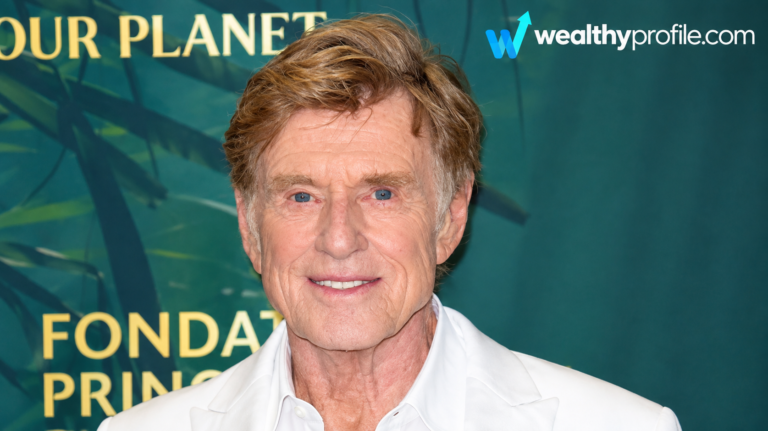
Robert Redford’s net worth at the time of his death on September 16, 2025, was estimated at approximately $200 million — a fortune assembled across six decades of acting, directing, producing, and the creation of an independent film empire that reshaped American cinema. Born Charles Robert Redford Jr. in Santa Monica, California, on August 18, 1936, the man who became Hollywood’s golden boy turned a $500 cabin purchase in the Utah mountains into the Sundance brand — a constellation of businesses spanning a film festival, a nonprofit institute, a mountain resort, a cable television channel, and a mail-order catalog company that together generated hundreds of millions in revenue over half a century.
His film career alone accounts for a significant share of that wealth. From a $500 paycheck for his first film role in 1962 to an $11 million salary for The Last Castle in 2001, Redford starred in some of the most commercially successful and culturally significant films of the twentieth century — Butch Cassidy and the Sundance Kid, The Sting, All the President’s Men, The Way We Were, Out of Africa, and The Natural. Behind the camera, his directorial debut Ordinary People won four Academy Awards including Best Director. Add a real estate portfolio that spanned Utah, California, Colorado, New York, and New Mexico, and the picture that emerges is of an artist who understood money not as an end but as a tool for building institutions that would outlast him.
He died in his sleep at his Sundance home in Utah at age eighty-nine — surrounded by the mountains he had spent a lifetime protecting.
In this article16 sections
- 01Quick Overview
- 02Early Life and Education
- 03The Rise to Stardom
- 04The Golden Decade
- 05Behind the Camera
- 06Later Acting Career and Retirement (1990–2019)
- 07The Sundance Empire
- 08Complete Wealth Breakdown
- 09Real Estate Portfolio
- 10Awards, Honors, and Cultural Recognition
- 11Environmental Activism
- 12Personal Life
- 13Death and Legacy
- 14Robert Redford Compared to Other Classic Hollywood Legends
- 15Timeline of Key Career and Financial Milestones
- 16Frequently Asked Questions
Quick Overview — Robert Redford Net Worth 2026
| Category | Details |
|---|---|
| Full Name | Charles Robert Redford Jr. |
| Date of Birth | August 18, 1936 |
| Date of Death | September 16, 2025 (age 89) |
| Birthplace | Santa Monica, California |
| Estimated Net Worth | $200 million |
| Primary Income Sources | Film acting and directing, Sundance empire, real estate, production companies |
| Notable Films | Butch Cassidy and the Sundance Kid, The Sting, All the President’s Men, Ordinary People, Out of Africa |
| Academy Awards | Best Director (Ordinary People, 1981), Honorary Award (2002) |
| Presidential Medal of Freedom | 2016 (awarded by President Barack Obama) |
| Sundance Founded | 1978 (Festival), 1981 (Institute) |
| Major Real Estate | Sundance Mountain Resort (2,600 acres, sold 2020), properties in Utah, California, Colorado, New Mexico, New York |
| Production Company | Wildwood Enterprises, Inc. |
| Marriages | Lola Van Wagenen (1958–1985), Sibylle Szaggars (2009–2025) |
| Children | Shauna, Amy, James (died 2020), Scott (died in infancy) |
| Cause of Death | Died peacefully in his sleep at Sundance, Utah |
Early Life and Education — From Van Nuys to the American Academy
Charles Robert Redford Jr. was born on August 18, 1936, in Santa Monica, California, to Martha Woodruff Hart, a Texas native, and Charles Robert Redford Sr., an accountant who worked for Standard Oil. The family was of Irish, Scottish, and English descent. Redford grew up in the Van Nuys neighborhood of Los Angeles, where he attended Van Nuys High School alongside future baseball Hall of Famer Don Drysdale.
By his own admission, Redford was a wayward teenager — skipping school, getting into minor legal scrapes, and showing more interest in art and the outdoors than academics. He earned a baseball scholarship to the University of Colorado at Boulder but lost it after eighteen months due to heavy drinking. The expulsion marked a turning point. He traveled to Europe, studied painting at the prestigious École des Beaux-Arts in Paris, and returned to New York to enroll at the Pratt Institute before discovering acting at the American Academy of Dramatic Arts, graduating with the Class of 1959.
His mother, Martha, died in 1955 from blood disorder complications when Redford was eighteen — a loss that profoundly shaped his emotional reserve and his lifelong reluctance to discuss personal matters publicly. He survived a mild case of polio at age eleven, a detail he rarely mentioned in interviews.
The Rise to Stardom — Broadway, Television, and the First Film Roles (1959–1969)
Redford’s professional career began on Broadway in 1959 with a small role in Tall Story. Television work followed quickly — guest appearances on Maverick (1960), Perry Mason (1960), The Twilight Zone (1962), and The Untouchables (1963). His performance in the television drama The Voice of Charlie Pont earned an Emmy nomination in 1962.
The Broadway production of Barefoot in the Park in 1963, opposite Elizabeth Ashley, established Redford as a leading man with commercial appeal. His transition to film accelerated with Inside Daisy Clover (1965), which won him a Golden Globe for Best New Star, and The Chase (1966) opposite Jane Fonda and Marlon Brando — the only time Redford and Brando shared the screen.
But the role that changed everything was the Sundance Kid. In 1969, Butch Cassidy and the Sundance Kid paired Redford with Paul Newman in a western buddy film that grossed over $100 million at the box office — equivalent to roughly $800 million adjusted for inflation. Redford earned $750,000 for the role, approximately $7 million in today’s dollars. The film transformed him from a promising actor into one of the biggest movie stars on the planet.
The Golden Decade — Peak Stardom and Peak Earnings (1970–1979)
The 1970s were Robert Redford’s decade. Between 1972 and 1976, he appeared in a string of films that defined an era of American cinema and established his earning power at levels few actors of his generation could match.
Jeremiah Johnson (1972) proved he could carry a film with minimal dialogue. The Candidate (1972) showcased his political instincts. The Way We Were (1973), opposite Barbra Streisand, became the fifth-highest-grossing film of the year and cemented his status as a romantic lead. Then came The Sting (1973), reuniting him with Paul Newman in a caper film that became the top-grossing picture of 1974 and earned Redford his only Academy Award nomination for Best Actor. His salary for that film was $500,000 — approximately $3.5 million today.
In 1974, Redford achieved something no performer had accomplished since Bing Crosby in 1946: three of his films appeared simultaneously among the year’s ten highest-grossing titles. Theater exhibitors voted him Hollywood’s top box-office draw for three consecutive years — 1974, 1975, and 1976.
All the President’s Men (1976), in which he played Washington Post journalist Bob Woodward opposite Dustin Hoffman as Carl Bernstein, became the second-highest-grossing film of its year and earned eight Academy Award nominations, winning four. Redford also served as executive producer — a signal that his ambitions extended beyond performing.
His salaries climbed accordingly. A Bridge Too Far (1977) paid $2 million, and The Electric Horseman (1979), his third film with Jane Fonda, paid $3.5 million — equivalent to roughly $15 million in 2026 dollars.
Behind the Camera — Directing Career and Academy Award (1980–2012)
In 1980, Redford made a directorial debut that few actors have ever matched. Ordinary People, a family drama about grief and emotional repression starring Mary Tyler Moore, Donald Sutherland, and Timothy Hutton, was produced on a $5.5 million budget and earned over $31 million at the box office. It swept the Academy Awards, winning Best Picture, Best Director for Redford, Best Adapted Screenplay, and Best Supporting Actor for Hutton. Roger Ebert called it “intelligent, perceptive and deeply moving.”
The Best Director Oscar established Redford as a serious filmmaker, not merely a movie star experimenting behind the camera. His subsequent directorial work, while commercially uneven, consistently earned critical respect. A River Runs Through It (1992) gave a young Brad Pitt his breakthrough role and earned a Golden Globe nomination for Redford. Quiz Show (1994), starring Ralph Fiennes and John Turturro, was hailed by Newsweek as evidence that Redford had become “more daring and accomplished” as a filmmaker. The Horse Whisperer (1998), in which he also starred opposite Kristin Scott Thomas and a young Scarlett Johansson, grossed over $186 million worldwide.
Later directorial efforts included The Legend of Bagger Vance (2000) with Matt Damon and Will Smith, The Conspirator (2010), and The Company You Keep (2012). While none replicated the commercial success of Ordinary People, each reflected Redford’s commitment to films that carried what he called “cultural weight.”
Later Acting Career and Retirement (1990–2019)
Redford continued to command significant paychecks through the 1990s and 2000s. Indecent Proposal (1993) paid $4 million. The Last Castle (2001) earned him a career-high $11 million base salary — equivalent to approximately $20 million in today’s dollars.
His later work prioritized artistic substance over blockbuster returns. All Is Lost (2013), a solo survival drama in which Redford spoke barely any dialogue, won the New York Film Critics Circle Award for Best Actor — his first win from that organization. The Old Man & the Gun (2018), a charming crime film based on a true story, earned a Golden Globe nomination and was announced as his final theatrical role.
The Marvel Cinematic Universe provided an unexpected late-career footnote. Redford played Alexander Pierce, a senior S.H.I.E.L.D. official secretly leading Hydra, in Captain America: The Winter Soldier (2014) and reprised the role briefly in Avengers: Endgame (2019). His final on-screen appearance was an uncredited voice cameo as Bob Woodward in HBO’s White House Plumbers (2023), and his final acting performance was a cameo in AMC’s Dark Winds in March 2025, just six months before his death.
The Sundance Empire — How a $500 Cabin Became a Global Brand
The financial story of Robert Redford cannot be told without the word Sundance. What began as a $500 purchase of a two-acre lot with an A-frame cabin in Timp Haven, a small Utah ski town, in 1961 evolved into one of the most influential cultural brands in American entertainment.
The Mountain Resort
By the late 1960s, flush with his Butch Cassidy earnings, Redford purchased approximately 3,000 additional acres surrounding his original cabin to prevent commercial developers from transforming the canyon. He renamed the area Sundance — after his most famous character — and began building what would become Sundance Mountain Resort at the base of the 12,000-foot Mount Timpanogos in the Wasatch Range.
Over the following decades, the resort grew to encompass 2,600 acres with 95 cottages, over 200 private homes, ski lifts, three restaurants (The Foundry Grill, The Tree Room, and the Owl Bar), and event spaces. In December 2020, Redford sold the resort to Broadreach Capital Partners and Cedar Capital Partners. The sale price was never publicly disclosed — a detail that makes precise net worth calculations difficult. The family retained 1,800 acres of adjacent property and partnered with Utah Open Lands to permanently protect over 300 acres as the Redford Family Elk Meadows Preserve.
The Sundance Film Festival
In 1978, Redford co-founded what was originally called the Utah/US Film Festival alongside Sterling Van Wagenen and John Earle. The event was designed to showcase American independent films outside the studio system. By the time it was renamed the Sundance Film Festival, it had become the largest independent film festival in the United States, exhibiting 125 feature-length films from 34 countries and drawing over 50,000 attendees annually to Park City and Salt Lake City.
The festival launched the careers of Steven Soderbergh, Quentin Tarantino, Darren Aronofsky, Ava DuVernay, and Ryan Coogler, among dozens of others. It generates tens of millions of dollars in annual revenue and transformed Park City from a quiet mining town into a global cultural destination. The economic impact on the state of Utah has been estimated in the hundreds of millions over the festival’s lifetime.
The Sundance Institute
Founded in 1981 as a nonprofit organization based in Park City, the Sundance Institute provides workshops, grants, and mentorship to independent filmmakers at every stage of development. The institute operates year-round and has supported thousands of projects that might never have found financing through traditional studio channels. It remains Redford’s most enduring institutional legacy — the organization most directly responsible for the explosion of independent cinema in the 1990s and 2000s.
Sundance Catalog and Sundance Channel
Redford expanded the Sundance brand into consumer products with the Sundance Catalog, founded in 1989, which sold apparel, jewelry, furniture, and art inspired by the American West. In 2004, he sold the majority stake in the catalog business to private equity firms ACI Capital and Webster Capital in a deal valued between $20 million and $40 million, retaining a small ownership interest.
The Sundance Channel, a 24-hour cable television network devoted to independent film, launched on February 29, 1996. Redford held an ownership stake alongside NBC Universal and CBS/Showtime. In 2008, Rainbow Media (owned by Cablevision, parent of AMC and IFC) acquired the channel for $496 million total, with Redford receiving a cash payment for his stake. The exact value of his share was not publicly disclosed, but as a founding partner, his payout was substantial.
Robert Redford Net Worth — Complete Wealth Breakdown
Robert Redford’s estimated $200 million net worth at the time of his death was built across multiple revenue streams accumulated over six decades. While no probate filing or estate disclosure has been made public, the documented sources of wealth include the following categories.
Film Acting Earnings
Redford’s acting career spanned from a $500 payday for War Hunt in 1962 to an $11 million salary for The Last Castle in 2001. His documented film salaries include $750,000 for Butch Cassidy and the Sundance Kid (1969), $500,000 for The Sting (1973), $2 million for A Bridge Too Far (1977), $3.5 million for The Electric Horseman (1979), $4 million for Indecent Proposal (1993), and $11 million for The Last Castle (2001). Beyond base salaries, residual payments from decades of theatrical reruns, home video, streaming licensing, and television broadcast rights contribute ongoing passive income to his estate.
Directing and Producing Revenue
As a director and producer through Wildwood Enterprises and Sundance Productions, Redford earned fees, profit participation, and royalties from films including Ordinary People ($31 million box office on a $5.5 million budget), A River Runs Through It, Quiz Show, The Horse Whisperer ($186 million worldwide), and television projects for CNN, PBS, and Discovery.
Sundance Business Revenue
The Sundance empire generated wealth through multiple channels: the resort operation (decades of revenue before the 2020 sale), the catalog business (sold for an estimated $20–$40 million in 2004), the channel ownership stake (part of a $496 million acquisition in 2008), and the festival’s ongoing operations. While the institute itself is a nonprofit, the festival and its associated commercial activities generate tens of millions annually.
Real Estate Portfolio
Redford’s real estate transactions over five decades represent both a lifestyle and an investment strategy. Documented transactions include his Manhattan penthouse at 1030 Fifth Avenue (purchased 1997 for $3.7 million, sold 2002 for $10 million), a Malibu oceanfront property (sold 2001 for $6 million, with an adjacent lot at $3 million), a St. Helena wine country estate (purchased for an undisclosed amount, sold 2019 for $7 million), a Tiburon home (purchased 2020 for $3.1 million, sold 2024 for $4.65 million), an Aspen ski lodge (purchased 2002 for $6.5 million), the Horse Whisperer Ranch near Sundance (30 acres, listed 2021 for $4.9 million), and properties in Santa Fe, New Mexico.
The Manhattan penthouse alone generated a $6.3 million profit. Across his lifetime real estate activity, documented transaction values exceed $60 million — and the undisclosed Sundance resort sale almost certainly added tens of millions more.
Real Estate Portfolio — Properties Across Five States
Redford’s relationship with real estate was inseparable from his identity. He was not a speculative investor flipping condos — he was a man who bought land to preserve it, built homes to live in them, and sold properties only when life circumstances required it.
His primary residence from the 1960s through his death was the Sundance property in Utah’s Wasatch Range, where the family retained 1,800 acres after the 2020 resort sale. The land sits at the base of Mount Timpanogos, and Redford built his original home there with his first wife Lola in 1963. He died in that home on September 16, 2025.
The breadth of his portfolio — spanning Utah, California (Malibu, St. Helena, Tiburon), Colorado (Aspen), New York (Manhattan), and New Mexico (Santa Fe) — reflected a man who loved landscapes and understood that premium real estate in iconic American locations appreciates reliably over time.
Awards, Honors, and Cultural Recognition
Robert Redford’s award shelf tells the story of a career that transcended entertainment. His major honors include the Academy Award for Best Director for Ordinary People (1981), the Academy Honorary Award (2002), five Golden Globe Awards including the Cecil B. DeMille Award (1994), three BAFTA Awards, the Screen Actors Guild Life Achievement Award (1996), the National Medal of Arts (1996, from President Clinton), the Kennedy Center Honors (2005), the Chevalier of the Légion d’honneur (2010, from President Sarkozy), the Presidential Medal of Freedom (2016, from President Obama), the Golden Lion for Lifetime Achievement at the Venice Film Festival (2017), and the Honorary César (2019).
President Obama, presenting the Medal of Freedom, called Redford “one of the foremost conservationists of our generation.” The honor recognized not just his film career but his decades of environmental advocacy through the Natural Resources Defense Council, his opposition to the Keystone Pipeline, and his partnership with Pitzer College to divest from fossil fuels.
Environmental Activism — The Cause That Defined His Later Years
If Sundance was Redford’s institution, environmentalism was his mission. He served as a longtime trustee of the Natural Resources Defense Council and worked for decades to protect public lands, oppose fossil fuel development, and promote sustainable practices.
His environmental consciousness traced back to childhood summers spent in Texas and California, where the contrast between open landscape and urban sprawl left a permanent impression. Working briefly in the oil fields as a young man reinforced his sense that extraction industries operated with insufficient regard for the land.
In 2012, Pitzer College named the Robert Redford Conservancy for Southern California Sustainability in his honor. In 2014, he helped lead the college’s decision to divest its endowment from fossil fuel stocks — at the time, the largest such commitment by a U.S. institution of higher education. TransCanada’s CEO identified Redford by name in 2013 as the leading figure in the anti-Keystone Pipeline protest movement.
His wife, Sibylle Szaggars Redford, founded “The Way of the Rain,” a nonprofit that raises environmental awareness through artistic performances. Redford served as vice president. The couple’s shared commitment to conservation was a defining feature of their marriage.
Personal Life — Marriages, Children, and Private Grief
Robert Redford married Lola Van Wagenen on August 9, 1958, and the couple had four children: Scott Anthony (who died of Sudden Infant Death Syndrome at two and a half months), Shauna Jean (a painter married to journalist Eric Schlosser, author of Fast Food Nation), David James “Jamie” Redford (a writer and filmmaker who died of bile duct cancer in October 2020 at age fifty-eight after two liver transplants), and Amy Hart (an actress, director, and producer). The marriage ended in divorce in 1985 after twenty-seven years.
In 1983, Shauna’s boyfriend Sidney Lee Wells was murdered — a tragedy that compounded the family’s earlier loss of infant Scott. The death of Jamie in 2020, just months before Redford sold the Sundance resort, was widely described as the most devastating blow of his later life. Redford rarely spoke about it publicly.
He married German painter Sibylle Szaggars on July 11, 2009, in Hamburg, Germany. She remained with him through the final sixteen years of his life. He is survived by Szaggars, daughters Shauna and Amy, and seven grandchildren.
Death and Legacy — September 16, 2025
Robert Redford died peacefully in his sleep on September 16, 2025, at his home at Sundance in the mountains of Utah. He was eighty-nine years old. His publicist Cindi Berger announced the death, and the family released a statement: “Robert Redford passed away on September 16, 2025, at his home at Sundance in the mountains of Utah — the place he loved, surrounded by those he loved.”
A private funeral was held, and Redford was buried on his Sundance property. The tributes that followed revealed the depth of his impact across entertainment, politics, and environmentalism. Jane Fonda, his co-star in five films, said: “He meant a lot to me and was a beautiful person in every way. He stood for an America that we have to keep fighting for.” Meryl Streep called him “one of the lions.” Barbra Streisand eulogized him at the 98th Academy Awards and briefly sang “The Way We Were.” Martin Scorsese, Ron Howard, Leonardo DiCaprio, and Bob Woodward all issued public statements honoring his legacy.
Variety described him as “a godfather for independent film.” The Guardian called him “a giant of American cinema.” President Obama’s 2016 Medal of Freedom citation — “one of the foremost conservationists of our generation” — served as an unofficial epitaph.
Robert Redford Compared to Other Classic Hollywood Legends
| Actor | Estimated Net Worth (at death or current) | Primary Wealth Source | Notable Legacy |
|---|---|---|---|
| Robert Redford | $200 million | Film career, Sundance empire, real estate | Sundance Film Festival, Best Director Oscar, Presidential Medal of Freedom |
| Paul Newman | $200 million | Film career, Newman’s Own ($600M+ donated) | Newman’s Own Foundation, 6 Oscar nominations |
| Clint Eastwood | $375 million | Film career, directing, real estate | 4 Oscar wins, Carmel-by-the-Sea mayor |
| Jack Nicholson | $400 million | Film career, art collection, real estate | 3 Oscar wins, 12 nominations (record) |
| Harrison Ford | $300 million | Film career (Star Wars, Indiana Jones) | Highest-grossing domestic box office actor |
| Al Pacino | $120 million | Film career, stage work | Oscar winner, Tony winner |
| Dustin Hoffman | $50 million | Film career, stage work | 2 Oscar wins, All the President’s Men co-star |
Redford’s $200 million net worth places him alongside his longtime friend and collaborator Paul Newman, and below peers Jack Nicholson and Clint Eastwood. The distinction is how Redford built his wealth. While most actors of his generation accumulated fortunes purely through performance fees and residuals, Redford invested in creating institutions — the Sundance Festival, Institute, resort, channel, and catalog — that generated independent revenue streams and cultural influence that extended far beyond any individual film role.
Timeline of Key Career and Financial Milestones
1936: Born Charles Robert Redford Jr. in Santa Monica, California (August 18).
1959: Graduates from the American Academy of Dramatic Arts; Broadway debut in Tall Story.
1961: Purchases two-acre cabin in Timp Haven, Utah, for $500.
1963: Stars in Broadway hit Barefoot in the Park.
1965: Wins Golden Globe for Best New Star for Inside Daisy Clover.
1969: Butch Cassidy and the Sundance Kid earns $100M+ at the box office; Redford earns $750,000. Acquires approximately 3,000 additional acres in Utah; renames the area Sundance.
1973: The Sting becomes #1 film of 1974; earns $500,000. The Way We Were is the year’s #5 hit.
1974: First actor since Bing Crosby (1946) with three films in the annual top-ten grossers.
1976: All the President’s Men becomes #2 film of the year; Redford also serves as executive producer.
1977: Earns $2 million for A Bridge Too Far.
1978: Co-founds the Utah/US Film Festival (later renamed Sundance Film Festival).
1979: Earns $3.5 million for The Electric Horseman.
1980: Directs Ordinary People; wins Academy Award for Best Director. Film earns $31M on $5.5M budget.
1981: Founds the Sundance Institute as a nonprofit for independent filmmakers.
1989: Launches Sundance Catalog business.
1993: Earns $4 million for Indecent Proposal.
1994: Receives Cecil B. DeMille Award at the Golden Globes.
1996: Receives Screen Actors Guild Life Achievement Award and National Medal of Arts. Sundance Channel launches.
1997: Purchases Manhattan penthouse for $3.7 million.
2001: Earns career-high $11 million for The Last Castle. Sells Malibu property for $6 million.
2002: Sells Manhattan penthouse for $10 million ($6.3M profit). Receives Academy Honorary Award. Purchases Aspen ski lodge for $6.5 million.
2004: Sells Sundance Catalog business for estimated $20–$40 million.
2005: Receives Kennedy Center Honors.
2008: Sundance Channel sold for $496 million total; Redford receives cash for his ownership stake.
2010: Appointed Chevalier of the Légion d’honneur by France.
2016: Receives Presidential Medal of Freedom from President Obama.
2018: Announces retirement after The Old Man & the Gun. Later says he “regretted” the announcement.
2019: Sells St. Helena wine country estate for $7 million. Receives Honorary César in Paris.
2020: Son James Redford dies of cancer at age 58. Sells Sundance Mountain Resort (2,600 acres) to Broadreach Capital and Cedar Capital Partners for an undisclosed sum. Purchases Tiburon home for $3.1 million.
2024: Sells Tiburon home for $4.65 million ($1.55M profit).
2025: Final acting appearance in AMC’s Dark Winds (March). Dies September 16 at Sundance, Utah, age 89.
Frequently Asked Questions — Robert Redford Net Worth 2026
How much was Robert Redford worth when he died?
Robert Redford’s net worth at the time of his death on September 16, 2025, was estimated at approximately $200 million. This figure, widely cited by Celebrity Net Worth and other financial tracking outlets, encompasses his accumulated film earnings, Sundance business proceeds, real estate portfolio, production company revenue, and ongoing residual payments from decades of film and television work. No probate filing has been made public to verify the exact estate value.
How did Robert Redford make his money?
Redford built his fortune through multiple channels: six decades of acting in over sixty films with salaries reaching $11 million per picture, Academy Award-winning directing, his production company Wildwood Enterprises, the Sundance business empire (resort, festival, catalog, television channel), and a real estate portfolio spanning five states. The sale of the Sundance Catalog in 2004 alone was valued at $20 to $40 million, and the 2008 Sundance Channel acquisition totaled $496 million across all ownership stakes.
Did Robert Redford own Sundance?
Yes. Redford purchased his first two acres in Utah’s Timpanogos area for $500 in 1961 and eventually acquired approximately 3,000 additional acres. He built the Sundance Mountain Resort, co-founded the Sundance Film Festival (1978) and the Sundance Institute (1981), launched the Sundance Catalog (1989), and co-owned the Sundance Channel (1996–2008). He sold the 2,600-acre resort in December 2020 to Broadreach Capital Partners and Cedar Capital Partners, though his family retained 1,800 acres of adjacent land.
What was Robert Redford’s highest-paid movie?
Robert Redford’s highest documented salary was $11 million for The Last Castle (2001), equivalent to approximately $20 million in 2026 dollars. His salary trajectory ranged from $500 for War Hunt (1962) to $750,000 for Butch Cassidy and the Sundance Kid (1969), $2 million for A Bridge Too Far (1977), $3.5 million for The Electric Horseman (1979), $4 million for Indecent Proposal (1993), and the $11 million career high.
Who inherited Robert Redford’s fortune?
The specific details of Robert Redford’s estate distribution have not been publicly disclosed. His survivors include his wife Sibylle Szaggars Redford, daughters Shauna Redford Schlosser and Amy Redford, and seven grandchildren. His son James Redford predeceased him in October 2020. Given the family’s history of privacy on financial matters, it is unlikely that detailed inheritance information will become public.
When did Robert Redford die?
Robert Redford died on September 16, 2025, peacefully in his sleep at his home at Sundance in the mountains of Utah. He was eighty-nine years old. His publicist Cindi Berger announced the death, and the family issued a brief statement requesting privacy.
How much did Robert Redford sell Sundance for?
The sale price of the Sundance Mountain Resort was never publicly disclosed. Redford sold the 2,600-acre resort to Broadreach Capital Partners and Cedar Capital Partners in December 2020. Real estate analysts have estimated the value at tens of millions of dollars based on comparable mountain resort transactions, but neither Redford nor the buyers confirmed a figure. The family retained 1,800 acres of adjacent property.
What awards did Robert Redford win?
Redford won the Academy Award for Best Director for Ordinary People (1981) and received the Academy Honorary Award in 2002. Additional honors include five Golden Globe Awards (including Best New Star and the Cecil B. DeMille Award), three BAFTA Awards, the Screen Actors Guild Life Achievement Award (1996), the National Medal of Arts (1996), the Kennedy Center Honors (2005), the Chevalier of the Légion d’honneur (2010), the Presidential Medal of Freedom (2016), the Venice Film Festival Golden Lion (2017), and the Honorary César (2019).
Was Robert Redford an environmental activist?
Yes. Redford was one of the most prominent environmental activists in American public life. He served as a longtime trustee of the Natural Resources Defense Council, led opposition to the Keystone Pipeline, helped Pitzer College divest from fossil fuels, and established the Robert Redford Conservancy for Southern California Sustainability. President Obama called him “one of the foremost conservationists of our generation” when presenting the Presidential Medal of Freedom in 2016.
How many movies did Robert Redford make?
Robert Redford appeared in over sixty films across a career spanning from 1960 to 2019, plus an uncredited voice cameo in 2023 and a final on-screen cameo in 2025. He directed ten feature films between 1980 and 2012. His combined filmography as actor, director, and producer encompasses nearly seventy credited theatrical and television projects.
Where did Robert Redford live?
Redford’s primary residence throughout most of his adult life was his property at Sundance in the Wasatch Range of Utah, at the base of Mount Timpanogos. He also maintained properties in Tiburon, California (sold 2024), Santa Fe, New Mexico, Aspen, Colorado, and previously in Manhattan, Malibu, and St. Helena, California. He died at his Sundance home.
Who was Robert Redford married to?
Redford was married twice. His first marriage to Lola Van Wagenen lasted from 1958 to 1985 and produced four children. His second marriage to German painter Sibylle Szaggars began on July 11, 2009, in Hamburg, Germany. Szaggars remained his wife until his death in September 2025.
You must read our other blogs :
Madison Beer Net Worth 2026 — How the YouTube Discovery Built an $18 Million Empire
Jackie Chan Net Worth 2026 — Inside the $400 Million Empire of Action Cinema’s Greatest Icon