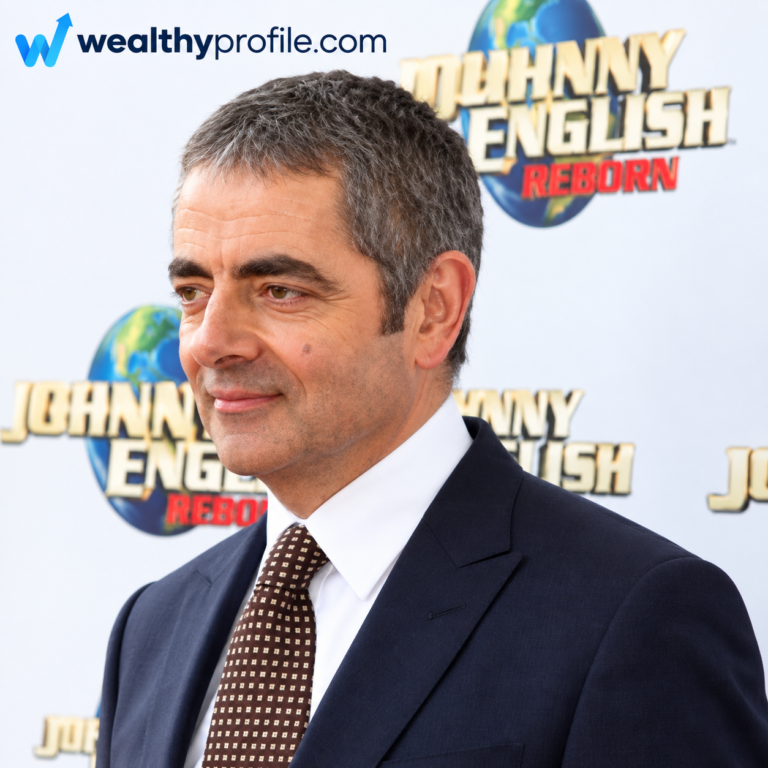
Rowan Atkinson net worth 2026 is estimated at approximately $150 million (£120 million), placing him among the wealthiest comedians in the world and the richest in British comedy history. The Oxford-educated electrical engineer turned comedy legend has built his fortune across nearly five decades through an extraordinary combination of television royalties, blockbuster film franchises, character licensing worth an estimated $80 million, a YouTube empire generating millions annually, strategic car investments that turned a $1 million purchase into a $12 million sale, and a real estate portfolio valued at over £15 million.
From the silent physical comedy of Mr. Bean to the sharp satirical wit of Blackadder, from the slapstick spy parodies of Johnny English to his Netflix comeback with Man vs. Bee and Man vs. Baby, Rowan Atkinson has demonstrated a rare ability to create characters that transcend language barriers, cultural boundaries, and generational divides. His films have collectively grossed over $1.1 billion at the worldwide box office, his YouTube channel has amassed over 32 million subscribers with billions of views, and his intellectual property continues to generate revenue streams that most actors can only dream of decades after their original broadcast.
This is the complete financial story of the man behind Mr. Bean — from a farm in County Durham to a £10 million glass mansion in Oxfordshire, from a student revue at the Edinburgh Fringe to a comedy empire worth $150 million.
In this article18 sections
- 01Quick Overview
- 02Early Life and Education
- 03The Comedy Breakthrough
- 04Blackadder
- 05Mr. Bean
- 06The Mr. Bean Films
- 07The Johnny English Franchise
- 08The Netflix Era
- 09YouTube Empire
- 10Rowan Atkinson Car Collection
- 11Rowan Atkinson Real Estate Portfolio
- 12Brand Endorsements and Commercial Work
- 13Other Notable Film and Voice Work
- 14Rowan Atkinson Income Breakdown
- 15Personal Life
- 16Awards, Honors, and Cultural Impact
- 17Rowan Atkinson Compared to Other British Comedy Fortunes
- 18Frequently Asked Questions (FAQs)
Quick Overview — Rowan Atkinson Net Worth 2026
| Category | Details |
|---|---|
| Full Name | Rowan Sebastian Atkinson |
| Date of Birth | January 6, 1955 |
| Age | 71 years old |
| Birthplace | Consett, County Durham, England |
| Nationality | British |
| Education | BSc Electrical Engineering (Newcastle University); MSc Electrical Engineering (The Queen’s College, Oxford) |
| Net Worth (2026) | $150 million (£120 million) |
| Annual Income (Est.) | $15–20 million |
| Primary Income Sources | Licensing/royalties (40%), YouTube revenue (20%), acting (20%), investments (20%) |
| Career Span | 1978–present (48 years) |
| Notable Roles | Mr. Bean, Edmund Blackadder, Johnny English, Trevor Bingley |
| Total Film Box Office | Over $1.1 billion worldwide |
| Partner | Louise Ford (since 2014) |
| Children | Ben (b. 1993), Lily (b. 1995), Isla (b. 2017) |
| Honors | CBE (2013), Olivier Award, 2 BAFTAs |
| Residence | Handsmooth House, Ipsden, Oxfordshire |
Early Life and Education — From a Durham Farm to Oxford University (1955–1978)
Rowan Sebastian Atkinson was born on January 6, 1955, in Consett, County Durham, England, to Eric Atkinson, a farmer and company director, and Ella May Bainbridge, who married on June 29, 1945. The youngest of four brothers — Paul, who died in infancy, Rodney, who became an economist and contested the UKIP leadership in 2000, and Rupert — Rowan grew up on the family farm in a household that placed little emphasis on entertainment.
His education followed an academic rather than artistic path. He attended Durham Chorister School as a preparatory student, then St. Bees School in Cumbria, a boarding school where a fellow student at the linked Durham Choristers was future British Prime Minister Tony Blair. At Newcastle University, Atkinson earned a BSc in Electrical and Electronic Engineering in 1975, then proceeded to The Queen’s College, Oxford, where he completed an MSc in Electrical Engineering. He was later made an Honorary Fellow of Queen’s College in 2006.
It was at Oxford that Atkinson’s trajectory shifted permanently. Through the Oxford University Dramatic Society, he met two collaborators who would shape his career: screenwriter Richard Curtis, who would later write Four Weddings and a Funeral, Notting Hill, and Love Actually, and composer Howard Goodall, who would score Blackadder, Mr. Bean, and The Thin Blue Line. Their partnership at the Edinburgh Festival Fringe in 1976 with the Oxford Revue produced the first public performances of what would become Atkinson’s signature physical comedy style.
The Comedy Breakthrough — Not the Nine O’Clock News and Stage Success (1979–1982)
Atkinson’s professional career began in 1979 with the BBC Radio 3 series The Atkinson People, which he co-wrote with Richard Curtis. That same year, he joined the cast of the BBC’s Not the Nine O’Clock News alongside Griff Rhys Jones, Mel Smith, and Pamela Stephenson. The satirical sketch show ran from 1979 to 1982 and won the BAFTA for Best Entertainment Performance in 1981, launching Atkinson into mainstream recognition at just twenty-six years old.
His stage work during this period was equally prolific. He performed at The Secret Policeman’s Ball in 1979 for Amnesty International, recorded a live stand-up special at the Grand Opera House in Belfast in 1980, and opened Rowan Atkinson in Revue at the Globe Theatre in London in 1981. The production won the Laurence Olivier Award, making Atkinson one of the youngest recipients at the time. In 1986, he became one of the rare British comedians to headline a Broadway theatre, performing at the Brooks Atkinson Theatre in a production aptly titled Rowan Atkinson at the Atkinson.
Blackadder — Four Series That Defined British Comedy (1983–1989)
The Blackadder series, which Atkinson co-created with Richard Curtis and later Ben Elton, ran for four series between 1983 and 1989, each set in a different historical period. Atkinson starred as Edmund Blackadder across every installment: the medieval The Black Adder (1983), the Elizabethan Blackadder II (1986), the Regency-era Blackadder the Third (1987), and the World War I Blackadder Goes Forth (1989).
The series earned Atkinson a second BAFTA for Best Entertainment Performance in 1990 and generated substantial residual income through decades of international syndication. The BBC has broadcast repeats continuously since the 1980s, and the show has been sold to broadcasters in over forty countries. Special episodes, including Blackadder’s Christmas Carol (1988), The Cavalier Years (1988), and Back & Forth (1999), extended the franchise and the associated royalty streams.
In a 2001 Channel 4 poll, Mr. Bean was voted the third greatest television character of all time, behind only Homer Simpson and Basil Fawlty, while Blackadder was voted among the greatest British sitcoms ever made in multiple polls. These rankings reflect the enduring cultural value of Atkinson’s creations and explain why residual payments continue to contribute meaningfully to his annual income nearly four decades after the first episode aired.
Mr. Bean — The Birth of a Global Comedy Empire (1990–1995)
The character that would define Atkinson’s fortune debuted on January 1, 1990, on Thames Television. Mr. Bean, the socially awkward, largely non-verbal character who navigates everyday situations through physical comedy and visual gags, was conceived by Atkinson and co-written with Richard Curtis and Robin Driscoll. The original television series consisted of just fifteen episodes broadcast between 1990 and 1995, yet it became one of the most widely broadcast comedy programs in television history, airing in over 190 countries.
The genius of Mr. Bean as a financial asset lies in the character’s near-total independence from language. Because the comedy is overwhelmingly physical, with minimal dialogue, the show requires virtually no dubbing or subtitling for international broadcast. This made the licensing economics extraordinarily favorable compared to dialogue-heavy sitcoms, as the same master tapes could be sold worldwide with minimal adaptation costs.
The financial value of the Mr. Bean intellectual property is estimated at approximately $80 million, encompassing television licensing, film rights, merchandise, animated series rights, and digital content revenue. Atkinson holds creator and co-writer credits on the original series, giving him a perpetual royalty stake in every revenue stream the character generates.
Mr. Bean: The Animated Series — Three Decades of Production
The animated adaptation of Mr. Bean has run in multiple series: the original Mr. Bean: The Animated Series (2002–2004), followed by additional seasons in 2015–2016, 2018–2019, and a continuation from 2025 to the present. Atkinson provides voice work for the character throughout, generating an additional income stream from a property that requires no physical on-camera performance. Tiger Aspect Productions, which produces the animated series, has sold the show to broadcasters globally, further expanding the character’s reach and revenue.
The Mr. Bean Films — $483 Million at the Worldwide Box Office
Bean: The Ultimate Disaster Movie (1997)
The first Mr. Bean feature film was produced on a budget of $18 million and became a global sensation, grossing $251.2 million worldwide, including $45.3 million domestically and over $205 million internationally. At the time of release, it was the fastest UK-produced film to cross the $100 million threshold, reaching that milestone before its American theatrical run even began.
Atkinson’s compensation for the film reportedly included a base salary plus a significant percentage of backend profits. Given the film’s $233 million profit margin over its production budget — before marketing — the backend points alone would have generated tens of millions in additional income.
Mr. Bean’s Holiday (2007)
The sequel, produced a decade later on a $25 million budget, grossed $232.2 million worldwide, including $33.3 million domestically and $198.9 million internationally. The film’s return of over nine times its production cost made it one of the most profitable comedy sequels of the 2000s and demonstrated that the Mr. Bean character had lost none of its international appeal in the twelve years since the television series ended.
Combined, the two Mr. Bean films generated $483.4 million in worldwide theatrical revenue against $43 million in combined production budgets.
The Johnny English Franchise — $486 Million and Counting
Atkinson’s second major film franchise originated, unusually, from a series of Barclaycard credit card advertisements in which he played Richard Latham, an incompetent spy. The character evolved into Johnny English, a bumbling MI7 agent in what became a three-film spy parody franchise produced by Working Title Films and distributed by Universal Pictures.
The franchise’s box office performance demonstrates remarkable consistency across international markets. Johnny English (2003) grossed $161.7 million worldwide, Johnny English Reborn (2011) earned $164.6 million, and Johnny English Strikes Again (2018) generated $159.4 million. The franchise total stands at approximately $485.7 million, with the overwhelming majority — $444.9 million, or 92% — coming from international markets. Strikes Again set an unusual record as the top-grossing studio comedy of 2018 by international box office despite earning just $4.4 million domestically.
Johnny English 4 — Filming in 2024–2025
A fourth installment was announced in February 2024, with production beginning that summer. Filming took place in the UK and Malta, with Working Title producing and Universal distributing. The film is expected to release in 2025 or 2026, marking Atkinson’s return to the franchise after a seven-year gap and potentially adding another $150–170 million to the franchise’s lifetime gross based on historical performance.
The Netflix Era — Man vs. Bee and Man vs. Baby (2022–2025)
Atkinson’s partnership with Netflix began with Man vs. Bee, a comedy series released in June 2022 in which he plays Trevor Bingley, a hapless housesitter who wages war against a bee in a luxurious mansion. The series, created and co-written by Atkinson and William Davies, became one of Netflix’s most-watched comedy programs, reaching Netflix’s global Top 10 in multiple countries.
The success led to a follow-up, Man vs. Baby, which premiered on Netflix on December 11, 2025. The four-episode series sees Trevor Bingley caring for an abandoned baby in a London penthouse over Christmas. Directed by David Kerr with Claudie Blakley, Nina Sosanya, and Rosie Cavaliero in the supporting cast, the show received positive reviews, scoring 72% on Rotten Tomatoes and 70 on Metacritic.
While Netflix deal terms remain confidential, comparable multi-season comedy deals with established international stars typically range from $5 million to $15 million per season. Atkinson’s dual role as creator, writer, and star likely positioned him at the higher end of that range, with additional compensation tied to viewership performance metrics.
YouTube Empire — The Mr. Bean Channel and Digital Revenue
The Mr. Bean YouTube channel, launched in 2006, has grown into one of the platform’s most successful entertainment channels, with over 32.6 million subscribers and aggregate views exceeding 10 billion. The channel generates approximately 46.27 million views per month, translating to estimated monthly ad revenue of approximately $185,000 and annual advertising income of $2.2–5 million.
In 2018, the channel earned a YouTube Diamond Play Button for surpassing 10 million subscribers. By July 2020, the Mr. Bean Facebook page had reached 94 million followers, making it one of the most followed entertainment pages on the platform and generating additional advertising and promotional revenue.
The channel’s content includes clips from the original television series, animated episodes, and compilation videos that perform exceptionally well in YouTube’s algorithm due to their visual nature and cross-cultural appeal. The absence of language barriers means the content attracts viewers from virtually every country, maximizing the channel’s geographic advertising reach and CPM rates across diverse markets.
Rowan Atkinson Car Collection — From Petrolhead to Strategic Investor
Atkinson is one of the entertainment industry’s most celebrated automobile enthusiasts, holding a Category C+E heavy goods vehicle license since 1981 and having competed in two seasons of club racing in a Renault 5 GT Turbo. His car collection has included some of the most significant automotive investments of the modern era.
The McLaren F1 — A $1 Million Investment That Returned $12 Million
The crown jewel of Atkinson’s collection was his McLaren F1, purchased new in 1997 for approximately $1 million (£640,000). Over eighteen years of ownership, he drove it over 41,000 miles — an extraordinary figure for a hypercar — and was involved in two significant accidents. The first, in October 1999 near Garstang, Lancashire, caused moderate damage. The second, in August 2011, resulted in a fire that required repairs costing £910,000 ($1.4 million), the largest motor insurance payout in British history at the time. Following the second crash, his annual insurance premium reportedly rose to approximately $100,000 per year.
Despite the accident history and accumulated mileage, Atkinson sold the McLaren F1 in June 2015 for approximately $12 million (£8 million), generating a profit of roughly $11 million on the original purchase. The sale represented one of the most profitable car investments in entertainment history and reflected the extraordinary appreciation of McLaren F1 values, which have continued to climb since, with pristine examples reaching $20 million or more.
The Broader Collection
Throughout his life, Atkinson has owned a remarkable range of vehicles reflecting both his engineering background and his appreciation for automotive diversity. Notable vehicles include an Aston Martin V8 Zagato, one of just fifty-two coupes produced, which he crashed at Croft Racing Circuit in July 2001 and subsequently rebuilt at a cost of approximately $340,000. He has also owned a 1939 BMW 328 Roadster valued at roughly $621,000, a Rolls-Royce Phantom Drophead Coupé, a Mercedes-Benz SLS AMG GT, a Honda NSX, an Aston Martin DBS V8, a Lancia Thema 8.32 with its Ferrari V8 engine, an Audi A8, a Škoda Superb, and even a Honda Civic Hybrid, reflecting his interest in both performance and efficiency.
In July 2011, Atkinson set the fastest lap time on Top Gear’s Star in a Reasonably Priced Car segment, recording 1:42.2 in a Kia Cee’d — a record that stood until it was beaten by Matt LeBlanc.
Rowan Atkinson Real Estate Portfolio — Over £15 Million in UK Property
Handsmooth House, Ipsden, Oxfordshire — The £10 Million Glass Mansion
Atkinson’s primary residence is Handsmooth House, a modernist glass mansion in the village of Ipsden, near the Chiltern Hills Area of Outstanding Natural Beauty in South Oxfordshire. The property was designed by Pritzker Prize-winning architect Richard Meier and represents one of the most ambitious private residential projects in the UK.
Atkinson purchased the land in 2006 for £2.5 million and invested an additional £5 million in construction, bringing the total investment to approximately £7.5 million. The project required years of planning approval and construction, with Atkinson finally moving in around 2022. The main house spans 8,000 square feet with five bedrooms, while a separate guest house with two additional bedrooms is connected by a bridge. Features include an atrium-style living room with floor-to-ceiling glass walls, an underground custom garage housing his car collection, solar panels, an outdoor swimming pool, and Japanese gardens designed by landscape architect Tom Stuart-Smith. The property is currently valued at approximately £10 million.
Hampstead, London — The Urban Base
Atkinson maintains a secondary property in Hampstead, one of London’s most prestigious residential neighborhoods, valued at approximately £4.65 million. The property provides urban access while his primary life is based in Oxfordshire.
Former Properties
Atkinson owned The Old Rectory at Waterperry, Oxfordshire, a Grade II-listed Georgian property, for over thirty years after purchasing it in 1982. He sold it in 2016 for £2.425 million. His Cotswolds mansion, an ultramodern estate that required a decade of planning approval, was transferred to his ex-wife Sunetra Sastry as part of their 2015 divorce settlement.
His total real estate holdings are valued at over £15 million, representing approximately 12% of his estimated net worth.
Brand Endorsements and Commercial Work
Atkinson has maintained a selective approach to commercial endorsements, choosing campaigns that align with his comedic persona rather than pursuing volume. His most notable advertising work includes the Barclaycard campaign, in which he played spy character Richard Latham — the advertisements were so successful that they directly inspired the Johnny English film franchise, effectively turning a commercial deal into a $486 million box office property.
In October 2014, Atkinson appeared as Mr. Bean in a global Snickers advertisement as part of the brand’s “You’re Not You When You’re Hungry” campaign, marking his return to advertising after an eighteen-year break. Earlier commercial work included campaigns for Kronenbourg beer, Fujifilm, Give Blood, and the UAE telecommunications company Etisalat, for which he filmed a February 2019 campaign featuring multiple character roles including a Scottish warrior, Victorian gentleman, football player, and racing driver.
Other Notable Film and Voice Work
Beyond his three signature franchises, Atkinson has contributed to numerous commercially successful productions. He voiced Zazu, the red-billed hornbill advisor, in Disney’s The Lion King (1994), which grossed $968 million worldwide in its original release. He played the memorably fumbling vicar in Four Weddings and a Funeral (1994), which grossed $245 million worldwide from a $4.4 million budget. He appeared as the meticulous jewelry salesman Rufus in Love Actually (2003), which grossed $247 million. His James Bond franchise appearance came in Never Say Never Again (1983).
In 2009, Atkinson took the role of Fagin in the West End revival of Oliver! at the Theatre Royal, Drury Lane — a significant stage commitment that demonstrated his range beyond comedy. Most recently, he appeared as Father Julius in Wonka (2023), the Willy Wonka prequel starring Timothée Chalamet, which grossed $634 million worldwide.
His total box office contribution across all films exceeds $1.1 billion, making him one of the highest-grossing comedy actors in cinema history despite appearing in relatively few films compared to his peers.
Rowan Atkinson Income Breakdown — Where the $150 Million Comes From
Atkinson’s wealth is distributed across multiple revenue streams, a diversification strategy that has proven remarkably resilient over his career.
Licensing and Royalties (Approximately 40% — $60 million): The single largest component of Atkinson’s wealth derives from the Mr. Bean intellectual property. As creator and co-writer of the original series, he holds perpetual royalty rights to the character across all media — television syndication in over 190 countries, film distribution, animated series, merchandise, and digital content. The estimated $80 million value of the Mr. Bean IP represents the capitalized value of these ongoing revenue streams. Additional royalties from Blackadder syndication and other television work contribute to this category.
YouTube and Digital Revenue (Approximately 20% — $30 million): The Mr. Bean YouTube channel’s 32.6 million subscribers and 46 million monthly views generate substantial advertising revenue, estimated at $2.2–5 million annually. Cumulative YouTube earnings since the channel’s 2006 launch likely exceed $25–30 million. Additional digital revenue from streaming platform licensing of Mr. Bean and Blackadder content supplements this income.
Acting Fees (Approximately 20% — $30 million): Atkinson’s film career has generated over $1.1 billion at the box office, with his compensation typically including base fees plus backend profit participation. His Netflix deal for Man vs. Bee and Man vs. Baby, his Johnny English franchise fees, and his selective film appearances generate significant per-project income.
Investments and Assets (Approximately 20% — $30 million): Atkinson’s car investments, particularly the $11 million profit on his McLaren F1, his real estate portfolio valued at over £15 million, and presumed financial investments constitute the remaining portion of his wealth.
Personal Life — Family, Relationships, and Life Beyond Comedy
Atkinson married makeup artist Sunetra Sastry in February 1990, and they had two children together: Ben Atkinson, born September 9, 1993, who went on to study at Exeter University, attend Sandhurst Royal Military Academy in 2016, and serve as a British Army officer with the Gurkhas; and Lily Atkinson Sastry, born July 11, 1995, who became a singer-songwriter, cabaret performer, and visual artist performing at London venues including the Pheasantry and St. James Studio.
After twenty-four years of marriage, Atkinson and Sastry divorced in November 2015 in a reportedly swift proceeding. The financial terms were not publicly disclosed, though Sastry received the couple’s Cotswolds property as part of the settlement.
Atkinson began a relationship with comedian and actress Louise Ford around 2013–2014, after they met during the comic play Quartermaine’s Terms. Their daughter, Isla Atkinson, was born in December 2017. The family resides at Handsmooth House in South Oxfordshire, where Atkinson and Ford maintain a relatively private life despite his global fame.
Awards, Honors, and Cultural Impact
Atkinson was appointed a Commander of the Order of the British Empire (CBE) in the 2013 New Year Honours for services to drama and charity. His other major accolades include a Laurence Olivier Award for his 1981 London stage show, two British Academy Television Awards for Best Entertainment Performance — for Not the Nine O’Clock News (1981) and Blackadder (1990) — and a Rose d’Or Award for Mr. Bean.
His cultural influence extends beyond awards. He was listed among the 50 funniest actors in British comedy by The Observer in 2003. In a 2005 poll of fellow comedians, he was named among the fifty greatest comedians of all time. He has been an outspoken advocate for free speech, leading a coalition in June 2005 with Nicholas Hytner, Stephen Fry, and Ian McEwan against the Racial and Religious Hatred Bill, and supporting the Reform Section 5 campaign in October 2012, which ultimately led Parliament to remove “insulting” language from the Public Order Act 1986 in February 2014.
Atkinson has publicly acknowledged a speech impediment — a stammer that occurs less frequently when he is performing. His comedy influences include Monty Python, John Cleese, Peter Sellers, Jacques Tati’s Monsieur Hulot character, and silent-era greats Charlie Chaplin, Buster Keaton, and Harold Lloyd.
Rowan Atkinson Compared to Other British Comedy Fortunes
| Comedian | Net Worth (2026 Est.) | Primary Source | Career Span |
|---|---|---|---|
| Rowan Atkinson | $150 million | Mr. Bean / Blackadder / Johnny English | 1978–present |
| Ricky Gervais | $140 million | The Office / stand-up / Netflix | 1998–present |
| John Cleese | $100 million | Monty Python / Fawlty Towers / A Fish Called Wanda | 1963–present |
| Steve Coogan | $25 million | Alan Partridge / Philomena / Stan & Ollie | 1989–present |
| Simon Pegg | $25 million | Shaun of the Dead / Mission Impossible / Star Trek | 1999–present |
| Sacha Baron Cohen | $160 million | Borat / Ali G / The Spy / Sweeney Todd | 1998–present |
| James Corden | $70 million | Late Late Show / Gavin & Stacey / Into the Woods | 2000–present |
Atkinson’s $150 million fortune places him firmly in the top tier of British comedy wealth, surpassed among UK-born comedians only by Sacha Baron Cohen. What distinguishes Atkinson’s financial profile is the dominance of intellectual property income — his wealth is overwhelmingly driven by characters he created rather than by salary-based employment, giving him a revenue structure more akin to a brand owner than a working actor.
Rowan Atkinson Net Worth 2026 — Frequently Asked Questions (FAQs)
How much is Rowan Atkinson worth in 2026?
Rowan Atkinson’s net worth in 2026 is estimated at approximately $150 million (£120 million). His wealth comes from a combination of Mr. Bean intellectual property licensing worth an estimated $80 million, film franchises that have collectively grossed over $1.1 billion worldwide, YouTube channel revenue generating $2.2–5 million annually from 32.6 million subscribers, a real estate portfolio valued at over £15 million, and selective acting roles including his Netflix partnership.
How did Rowan Atkinson make his money?
Atkinson built his fortune primarily through the creation and ownership of intellectual property rather than through salary alone. His income breaks down to approximately 40% from licensing and royalties on the Mr. Bean character across television, film, animation, merchandise, and digital platforms; 20% from YouTube and digital revenue; 20% from acting fees including film backend points; and 20% from investments including his car collection and real estate. The Mr. Bean character, which he co-created, generates revenue in over 190 countries without requiring language adaptation.
How much did Rowan Atkinson sell his McLaren F1 for?
Atkinson sold his McLaren F1 in June 2015 for approximately $12 million (£8 million). He had originally purchased the car new in 1997 for approximately $1 million (£640,000), generating a profit of roughly $11 million despite having driven it 41,000 miles and crashed it twice — including a 2011 incident that resulted in a £910,000 insurance repair, the largest motor insurance payout in British history at the time.
Does Rowan Atkinson still earn money from Mr. Bean?
Yes. Atkinson continues to earn substantial income from Mr. Bean through multiple channels. The Mr. Bean YouTube channel generates an estimated $2.2–5 million annually from 32.6 million subscribers and 46 million monthly views. The animated series continues with new seasons from 2025. Television syndication royalties from the original series continue across 190+ countries. Character licensing and merchandise generate ongoing revenue from an IP valued at approximately $80 million.
What is the Mr. Bean YouTube channel worth?
The Mr. Bean YouTube channel has over 32.6 million subscribers with aggregate views exceeding 10 billion. It generates approximately 46.27 million views per month and an estimated $2.2–5 million in annual advertising revenue. Based on its subscriber base, view rate, and revenue potential, the channel’s estimated capitalized value is $11–15 million, making it one of the most valuable entertainment channels on the platform.
How much did the Mr. Bean and Johnny English movies make at the box office?
The two Mr. Bean films grossed a combined $483.4 million worldwide: Bean (1997) earned $251.2 million on an $18 million budget, and Mr. Bean’s Holiday (2007) earned $232.2 million on a $25 million budget. The three Johnny English films grossed a combined $485.7 million worldwide. Together, these five films alone generated $969 million in theatrical revenue, with a fourth Johnny English film in production.
Is Rowan Atkinson the richest comedian in the UK?
Atkinson is among the richest, with his $150 million fortune placing him second among UK-born comedians behind Sacha Baron Cohen at approximately $160 million. He is ahead of Ricky Gervais ($140 million), John Cleese ($100 million), and James Corden ($70 million). His wealth is distinctive for its reliance on intellectual property ownership rather than salary, giving him an ongoing revenue base independent of active work.
How much did Rowan Atkinson earn per episode of Mr. Bean?
Specific per-episode fees for the original 1990–1995 Mr. Bean series have not been publicly disclosed. However, as co-creator, co-writer, and sole star of a series that aired just fifteen episodes yet generated a global franchise worth hundreds of millions, Atkinson’s total compensation far exceeds the original production fees. His ongoing royalties from the fifteen original episodes — through syndication, streaming, and YouTube — likely generate several million dollars annually, decades after the final episode aired.
What cars does Rowan Atkinson own in 2026?
Following the $12 million sale of his McLaren F1 in 2015, Atkinson’s known collection includes a Rolls-Royce Phantom Drophead Coupé, a Mercedes-Benz SLS AMG GT, a Honda NSX, an Aston Martin DBS V8, an Audi A8, a Škoda Superb, and a Honda Civic Hybrid. His collection reflects his engineering background, favoring mechanical distinction and driving experience over pure showmanship. He houses his cars in a custom underground garage at his Oxfordshire home.
Is Rowan Atkinson still acting in 2026?
Yes, Atkinson remains actively working. Man vs. Baby, his Netflix Christmas special sequel to Man vs. Bee, premiered in December 2025. Johnny English 4, the fourth installment of his spy parody franchise, filmed in 2024 in the UK and Malta and is expected to release in 2025 or 2026. The Mr. Bean animated series continues with new episodes from 2025. At seventy-one, Atkinson shows no signs of retirement, with multiple projects either recently completed or in development.
Where does Rowan Atkinson live?
Atkinson’s primary residence is Handsmooth House in Ipsden, South Oxfordshire, a modernist glass mansion designed by Pritzker Prize-winning architect Richard Meier. He purchased the land in 2006 for £2.5 million and invested £5 million in construction, with the property now valued at approximately £10 million. The 8,000-square-foot main house features five bedrooms, an underground car garage, solar panels, a swimming pool, and Japanese gardens. He also maintains a £4.65 million property in Hampstead, London.
What is Rowan Atkinson’s educational background?
Atkinson holds a BSc in Electrical and Electronic Engineering from Newcastle University (1975) and an MSc in Electrical Engineering from The Queen’s College, Oxford. He was made an Honorary Fellow of Queen’s College in 2006. His engineering education distinguishes him from most comedians and has influenced his methodical, precision-driven approach to physical comedy. He has described his comedy as being constructed with an engineer’s attention to timing and mechanics.
You must read our other blogs :
Harvey Weinstein Net Worth 2026 — From $300 Million Hollywood Mogul to $25 Million Behind Bars
Jeffrey Epstein Net Worth 2026 — The Shocking $578M Fortune, Where It Came From, and What Remains