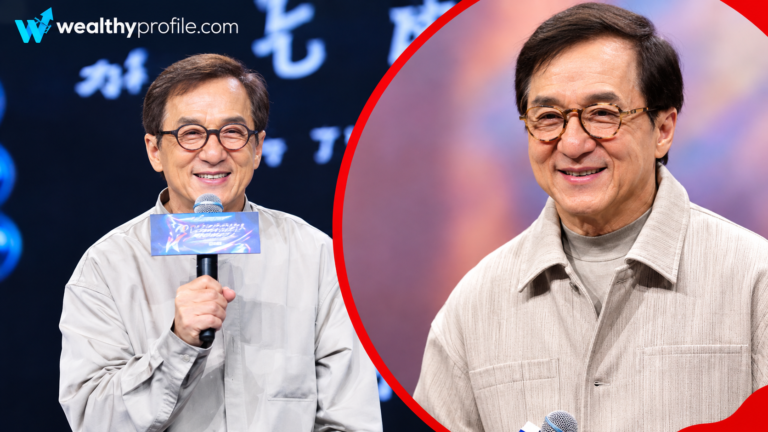
Jackie Chan’s net worth in 2026 is estimated at approximately $400 million, according to Celebrity Net Worth, Forbes, and multiple financial reporting outlets. The Hong Kong-born martial artist, actor, filmmaker, and entrepreneur built that fortune across a sixty-year career spanning over 200 films that have collectively grossed more than $6 billion at the worldwide box office. His income sources extend far beyond film salaries — encompassing production companies including JCE Movies Limited, a cinema chain with plans for 65 locations across China, restaurant franchises in Hong Kong, South Korea, and Southeast Asia, global brand endorsements, a clothing line, and a music career spanning more than twenty albums. Forbes ranked him as the world’s second highest-paid actor in 2015 with $50 million in annual earnings, and he remained in Forbes’ top five through 2018, earning approximately $45 million that year. At seventy-two years old, Chan continues to add to his legacy — his 2025 film Karate Kid: Legends crossed $50 million at the global box office, and his 2016 Academy Honorary Oscar remains the crowning institutional recognition of a career that fundamentally reshaped what action cinema could be.
In this article16 sections
- 01Quick Overview
- 02Early Life and Training
- 03Film Career
- 04Salary Per Movie and Biggest Paydays
- 05Forbes Rankings
- 06Business Ventures
- 07Real Estate Portfolio
- 08Music Career
- 09Awards and Recognition
- 10Philanthropy
- 11The Inheritance Controversy
- 12Personal Life
- 13Political Views and Controversies
- 14Jackie Chan Compared to Other Highest-Paid Action Stars
- 15Cultural Impact and Legacy
- 16Frequently Asked Questions
Quick Overview — Jackie Chan Net Worth 2026
| Category | Details |
|---|---|
| Full Name | Chan Kong-sang (陳港生) / Fang Shilong (房仕龍) |
| Known As | Jackie Chan / Sing Lung (成龍) |
| Date of Birth | April 7, 1954 |
| Age (2026) | 72 years old |
| Birthplace | Victoria Peak, Hong Kong (British Hong Kong) |
| Nationality | Chinese (Hong Kong) |
| Education | China Drama Academy (Peking Opera School) |
| Career | Actor, filmmaker, martial artist, producer, singer, entrepreneur |
| Net Worth (2026) | ~$400 million |
| Peak Annual Earnings | ~$61 million (2016, Forbes) |
| Career Film Gross | $6+ billion worldwide |
| Total Films | 200+ |
| Spouse | Joan Lin (married December 1982) |
| Children | Jaycee Chan (son), Etta Ng Chok Lam (daughter) |
| Key Business Ventures | JCE Movies, cinema chain, Jackie’s Kitchen, restaurants, clothing line |
| Signature Franchise | Rush Hour ($845M combined gross) |
| Major Award | Academy Honorary Oscar (2016) |
| Philanthropy | Jackie Chan Charitable Foundation, Dragon’s Heart Foundation |
Early Life and Training — From Victoria Peak to the China Drama Academy
Chan Kong-sang was born on April 7, 1954, at Victoria Peak in British Hong Kong to Charles Chan and Lee-Lee Chan, political refugees who had fled mainland China during the Chinese Civil War. His father, originally named Fang Daolong, had briefly worked as an intelligence operative before escaping to Hong Kong in the 1940s. Both parents found employment at the French consul’s residence on Victoria Peak, where the young Chan Kong-sang spent his earliest years.
Chan attended Nah-Hwa Primary School on Hong Kong Island but failed his first year and was withdrawn by his parents. In 1960, at age six, his father enrolled him at the China Drama Academy — a Peking Opera boarding school run by the legendary Master Yu Jim-yuen. For the next decade, Chan endured the rigorous and often brutal training regime of classical Chinese opera, studying martial arts, acrobatics, singing, and dramatic performance alongside fellow students who would become lifelong collaborators — including Sammo Hung and Yuen Biao, with whom he would later form the “Three Dragons” of Hong Kong cinema.
At the academy, Chan adopted the stage name Yuen Lo in homage to his master. He became part of the Seven Little Fortunes, an elite performance group drawn from the school’s most talented students. The decade of intensive physical training — up to nineteen hours daily — would become the foundation of every extraordinary stunt, every impossible physical comedy sequence, and every bone-breaking action scene of his entire career.
When his parents emigrated to Canberra, Australia, in 1971 to work at the American Embassy, the seventeen-year-old Chan briefly joined them. He attended Dickson College and worked construction, where a fellow builder named Jack gave him the nickname “Little Jack” — later shortened to “Jackie,” the English name that would become famous worldwide.
Film Career — Six Decades, 200 Films, and $6 Billion at the Box Office
The Bruce Lee Shadow and the Birth of Comedy Kung Fu (1970s)
Jackie Chan’s film career began in childhood — he appeared in his first small role at age five and at age eight played a credited part in Big and Little Wong Tin Bar (1962). Through the early 1970s, he worked as an extra and stunt double in Hong Kong films, including appearances in Bruce Lee’s Fist of Fury (1972) and Enter the Dragon (1973). He served as martial arts choreographer for John Woo’s The Young Dragons in 1974.
After Bruce Lee’s death in 1973, the Hong Kong film industry scrambled to find “the next Bruce Lee.” Producer Lo Wei signed Chan in 1976 and gave him the Chinese stage name Sing Lung (成龍, meaning “becoming the dragon”), explicitly positioning him as Lee’s successor. The strategy failed — Chan was not Bruce Lee, and audiences could tell.
The breakthrough came in 1978, when director Yuen Woo-ping cast Chan in Snake in the Eagle’s Shadow, allowing him to play to his natural strengths: physical comedy, acrobatic ingenuity, and a likeable underdog persona. The same year, Drunken Master became a massive hit and established the comedy kung fu genre that Chan would dominate for decades. Rather than imitating Lee’s intense, disciplined warrior, Chan created the polar opposite — a well-meaning, slightly foolish everyman who triumphs through improvisation, resilience, and superhuman acrobatic ability.
Hong Kong Dominance — Police Story, Project A, and the Three Dragons (1980s)
The 1980s cemented Chan as the biggest star in Asian cinema. The Fearless Hyena (1979) marked his directorial debut. The Young Master (1980) broke Bruce Lee’s Hong Kong box office records. Project A (1983) saw the formation of the Jackie Chan Stunt Team, which would perform alongside him in every subsequent film. Police Story (1985) won Best Film at the 1986 Hong Kong Film Awards and is widely regarded as one of the greatest action films ever made.
Throughout this decade, Chan, Sammo Hung, and Yuen Biao — the “Three Dragons” from the China Drama Academy — starred together in six films including Wheels on Meals (1984) and Dragons Forever (1988), creating a run of ensemble action comedies that remain benchmarks of the genre.
Armour of God (1986) grossed over HK$35 million but nearly cost Chan his life — a fall from a tree during filming fractured his skull, and he came closer to death than at any other point in his career. The incident epitomized his commitment to performing his own stunts, a practice that has left him with a dislocated pelvis, broken fingers, toes, nose, both cheekbones, hips, sternum, neck, ankle, and ribs over the course of his career. He holds the Guinness World Record for “Most Stunts by a Living Actor.”
The Hollywood Crossover — Rush Hour and Global Stardom (1990s–2000s)
Chan’s path to Hollywood was not immediate. His first American film, The Big Brawl (1980), flopped. A minor role in The Cannonball Run (1981) introduced him to Western audiences, but The Protector (1985) was another commercial failure, and Chan temporarily abandoned the American market.
The breakthrough came with Rumble in the Bronx (1995), which proved Chan could draw North American audiences. Three years later, Rush Hour (1998) paired him with Chris Tucker and grossed $244 million worldwide — making Chan, at forty-four, a legitimate Hollywood star.
The Rush Hour franchise became the cornerstone of his international earnings. Rush Hour 2 (2001) grossed $347 million worldwide, and Rush Hour 3 (2007) added $255 million more. Combined, the three films grossed approximately $845 million at the global box office.
Shanghai Noon (2000) and Shanghai Knights (2003) with Owen Wilson provided another successful franchise. The Karate Kid (2010), in which Chan played Mr. Han opposite Jaden Smith, grossed $359 million worldwide and introduced him to an entirely new generation of fans.
Return to Chinese Cinema and the Asian Market (2010s–Present)
From the late 2000s onward, Chan increasingly shifted his focus back to Chinese-language films, where his earning power remained extraordinary. Kung Fu Yoga (2017) became the fifth highest-grossing film in Chinese history. The Foreigner (2017) with Pierce Brosnan demonstrated his dramatic range. CZ12 (2012), his directorial passion project, earned him two Guinness World Records — for “Most Stunts Performed by a Living Actor” and “Most Credits in One Movie.”
In 2025, Chan returned to Hollywood with Karate Kid: Legends, reprising his role as Mr. Han. The film opened to $17 million domestically and crossed $50 million at the global box office, confirming that even at seventy-one, Chan remained a bankable international star.
Jackie Chan Net Worth 2026 — Salary Per Movie and Biggest Paydays
Jackie Chan’s per-film compensation has varied dramatically depending on the market and the deal structure. His contracts typically include an upfront salary plus “backend points” — a percentage of gross or net profits that can multiply his earnings several times over.
Rush Hour Franchise Earnings
The Rush Hour trilogy represents Chan’s single largest filmography payday. For Rush Hour 2 and Rush Hour 3, he reportedly earned $15 million per film in upfront salary plus 15 percent of gross earnings. Given the franchise’s combined $845 million box office, his backend participation generated an estimated $126.75 million in additional earnings across the two sequels alone. Including the first film, his total Rush Hour franchise earnings are estimated between $140 million and $160 million.
Per-Film Salary Structure
| Market | Typical Upfront Salary | Backend Structure |
|---|---|---|
| Hollywood films | $10–15 million | 10–15% of gross |
| Hong Kong/Chinese films | $5–10 million | Profit participation percentage |
| 1996 Hong Kong rate | HK$30 million (~$4M USD) | Plus profit share |
Biggest Movie Paydays (Estimated)
| Film | Year | Box Office (Worldwide) | Est. Total Earnings |
|---|---|---|---|
| Rush Hour 2 | 2001 | $347 million | $50–60 million |
| Rush Hour 3 | 2007 | $255 million | $40–50 million |
| Rush Hour | 1998 | $244 million | $15–20 million |
| The Karate Kid | 2010 | $359 million | $20–30 million |
| Kung Fu Yoga | 2017 | $254 million | $15–25 million |
| Shanghai Noon | 2000 | $99 million | $8–12 million |
| Shanghai Knights | 2003 | $88 million | $10–15 million |
Forbes Rankings — A Decade Among the Highest-Paid Actors in the World
Jackie Chan appeared on Forbes’ highest-paid actor list for multiple consecutive years, a testament to his sustained earning power across both Asian and Western markets.
| Year | Forbes Ranking | Estimated Annual Earnings |
|---|---|---|
| 2015 | #2 Highest-Paid Actor | ~$50 million |
| 2016 | #2 Highest-Paid Actor | ~$61 million |
| 2017 | #5 Highest-Paid Actor | ~$49 million |
| 2018 | #5 Highest-Paid Actor | ~$45 million |
| 2019 | Top 10 Celebrities | ~$58 million |
| 2020 | #80 Highest-Paid Celebrity | ~$40 million |
His consistent presence at the top of Forbes’ rankings through the late 2010s reflected not just his film salary but the combined power of his endorsement deals, production company revenue, and business ventures — income streams that most Western actors of comparable fame do not possess.
Business Ventures — Production Companies, Cinemas, Restaurants, and More
JCE Movies Limited
In 2003, Chan established JCE Movies Limited (Jackie Chan Emperor Movies Limited) in partnership with Emperor Multimedia Group. The production company has produced and co-produced numerous Chinese-language films, allowing Chan to control creative direction while capturing producer-level profits rather than actor-only compensation. Additional production entities include JC Group China, Jackie & Willie Productions (with long-time manager Willie Chan), and Jackie & JJ Productions.
Jackie Chan Cinema Chain
Chan partnered with Sparkle Roll Group Ltd to create Jackie Chan Theater International, a cinema chain targeting China’s booming theatrical market. The flagship Jackie Chan-Yaolai International Cinema opened in February 2010, claiming the title of China’s largest cinema complex with seventeen screens and 3,500 seats. The partnership announced plans for sixty-five cinemas across Beijing, Shanghai, and Guangzhou — an investment in physical theatrical infrastructure that generates ongoing revenue independent of any single film’s performance.
Restaurant Franchises
Chan operates multiple restaurant brands across Asia. Jackie’s Kitchen, a sushi chain, has outlets in Hong Kong and seven locations in South Korea, with planned expansion to Las Vegas. Jackie Chan’s Cafe has locations in Beijing, Singapore, and the Philippines. Combined, the restaurant portfolio diversifies his income into the food and hospitality sector.
Additional Business Ventures
Chan’s business empire extends to a clothing line launched in 2004 featuring the Chinese dragon logo with “Jackie” or “JC” initials, Jackie Chan Signature Club gyms (in partnership with California Fitness), and consumer food products including a line of chocolates, cookies, and nutritional oatcakes.
Motorsport
In 2016, Chan partnered with Asian Le Mans Series champion David Cheng to form Jackie Chan DC Racing (originally Baxi DC Racing Alpine). At the 2017 24 Hours of Le Mans, the team became the first Chinese-flagged entry to win the LMP2 class — a historic achievement in international motorsport that added competitive racing to Chan’s portfolio of business interests.
Real Estate Portfolio — Beverly Hills, Hong Kong, Beijing, and Beyond
Jackie Chan’s real estate holdings span multiple continents and represent a significant portion of his $400 million net worth.
Beverly Hills Mansion
Chan owns a luxury mansion in Beverly Hills, California, listed and valued at approximately $14.3 million. The 7,600-square-foot property features a swimming pool and sits in one of the most exclusive residential neighborhoods in the world.
Hong Kong Properties
Chan’s primary residence is in Kowloon Tong, Hong Kong. He also holds significant land parcels and residential properties across Hong Kong, consistent with his deep roots in the city’s real estate market and his status as its most famous living actor.
Beijing Apartments
In 2006, Chan purchased luxury apartments in Beijing for approximately $4.9 million. By 2020, these properties had appreciated to an estimated market value of $14.6 million. However, the apartments became the subject of an ownership dispute with Yujia Real Estate, leading to a forced auction with a starting bid of $10.5 million — a legal complication that highlighted the risks of real estate investment in mainland China.
Historic Chinese Houses
Chan is known to collect antique Chinese houses and historic structures. He has donated several of these to municipalities for preservation, blending his property interests with his philanthropic activities.
Music Career — Twenty Albums and Olympic Performances
An aspect of Chan’s career often overlooked in Western media is his prolific music career. Operatically trained at the China Drama Academy, he has released more than twenty albums since 1984, performing in Cantonese, Mandarin, Japanese, Taiwanese, and English. He recorded the theme songs for many of his own films, including “Story of a Hero” from Police Story — later adopted by the Royal Hong Kong Police for a 1994 recruitment advertisement.
His most culturally significant musical moment came at the 2008 Beijing Summer Olympics, where he performed “We Are Ready” as the official one-year countdown anthem and sang “Hard to Say Goodbye” alongside Andy Lau, Liu Huan, and Wakin Chau at the closing ceremony.
He also voiced the character Shang in the Chinese-language release of Disney’s Mulan (1998) and performed the Mandarin version of “I’ll Make a Man Out of You.”
Awards and Recognition — The Honorary Oscar and Sixty Years of Accolades
Academy Honorary Award (2016)
On November 12, 2016, Jackie Chan received the Academy Honorary Award (Governors Award) at the 8th Annual Governors Awards ceremony. The Oscar recognized “extraordinary achievements in film” across five decades and more than two hundred films. Chan became the first Chinese actor to receive an Honorary Oscar and only the fourth person of Asian descent to receive any Academy Award.
At the ceremony, Chan said he had dreamed of holding an Oscar since watching the ceremony as a child. Chris Tucker, who presented alongside other collaborators, noted that Chan’s work had influenced an entire generation of filmmakers. NBC News described the moment as the culmination of “five decades and 200 movies.”
Other Major Awards
Chan’s awards span virtually every major recognition body in Asian and international entertainment. The Hong Kong Film Awards honored Police Story as Best Film and gave Chan multiple Best Action Choreography wins. The Golden Horse Film Festival awarded him Best Actor for Police Story 3: Super Cop (1993). He received the Lifetime Achievement Award from the Asia Pacific Film Festival in 1993. At the 2019 Martial Arts History Museum, he was inducted into the Hall of Fame.
He has stars on both the Hong Kong Avenue of Stars and the Hollywood Walk of Fame, with handprints and footprints at Grauman’s Chinese Theatre. In 1989, he received the Order of the British Empire (MBE), and in 1999, the Silver Bauhinia Star from the Hong Kong government.
In 2025, at the premiere of Karate Kid: Legends, the World Karate Federation awarded Chan an honorary black belt alongside Ralph Macchio.
Philanthropy — Pledging Half His Fortune and Building Schools Across China
Jackie Chan’s philanthropic commitments are among the most substantial of any living entertainer. In June 2006, he publicly pledged to donate at least half of his assets to charity upon his death, citing admiration for Warren Buffett and Bill Gates.
Jackie Chan Charitable Foundation
Founded in 1988, the Jackie Chan Charitable Foundation provides scholarships for Hong Kong youth and delivers aid to victims of natural disasters and serious illness. The foundation has been active for nearly four decades, predating many of Chan’s highest-earning years.
Dragon’s Heart Foundation
Established in 2005, the Dragon’s Heart Foundation focuses on education in rural China, building schools, providing textbooks and uniforms, and covering school fees for children in remote areas. The foundation expanded to Europe in 2011 and also donates clothing and wheelchairs to elderly individuals.
Disaster Relief
Chan has been personally involved in major disaster relief efforts throughout his career. After the 2008 Sichuan earthquake, he donated RMB ¥10 million (approximately $1.5 million at the time). Following the 2011 Tōhoku earthquake and tsunami in Japan, he headlined the three-hour charity concert “Artistes 311 Love Beyond Borders,” raising over $3.3 million. In 2017, he donated $65,000 to Thailand flood victims. He has also contributed to relief efforts for mainland China floods and the 2004 Indian Ocean tsunami.
Institutional Contributions
Chan funded the Jackie Chan Science Centre at the Australian National University’s John Curtin School of Medical Research, launched in March 2008 by Australian Prime Minister Kevin Rudd. He serves as Dean of the Jackie Chan Film and Television Academy at Wuhan Institute of Design and Sciences and teaches tourism management at the Hong Kong Polytechnic University.
Forbes named him one of the top ten most charitable celebrities in 2011. He serves as a UNICEF Goodwill Ambassador and actively campaigns for wildlife conservation and animal welfare.
The Inheritance Controversy — “If He Is Capable, He Can Make His Own Money”
One of the most discussed aspects of Chan’s financial life is his stated intention not to leave his fortune to his children. In multiple interviews, he has said he plans to donate the entirety — or near-entirety — of his wealth to charitable causes rather than passing it to his son Jaycee Chan.
His most widely quoted statement on the subject: “If he is capable, he can make his own money. If he is not, then he will just be wasting my money.” The remark, first reported around 2011, generated significant public debate about wealth, inheritance, and parental responsibility among Asian celebrity circles. Whether his plans have evolved since that statement remains unclear, and no public update has confirmed or contradicted the original declaration as of 2026.
Personal Life — Joan Lin, Jaycee Chan, and Family Controversies
Marriage to Joan Lin
Chan married Taiwanese actress Joan Lin on December 1, 1982. Their son Jaycee Chan was born the following day. Joan Lin, a major film star in her own right, largely retired from acting after their marriage. The couple has remained married for over forty-three years as of 2026, though their relationship has weathered significant public controversy.
Jaycee Chan
Jaycee Chan pursued careers in both music and acting, appearing in films including The Medallion (2003) alongside his father. In August 2014, Jaycee was arrested in Beijing for cannabis possession and use. He was sentenced to six months in detention and served 148 days. Jackie Chan publicly expressed that he was “angry, shocked, heartbroken, and ashamed,” and stated that his son should accept the consequences of his actions.
Etta Ng Chok Lam
In 1999, Chan acknowledged an extramarital affair with Hong Kong actress Elaine Ng Yi-Lei, which resulted in the birth of their daughter, Etta Ng Chok Lam, on January 18, 1999. At a press conference, Chan expressed regret, stating he had “only committed a fault that many men in the world commit.”
Chan has reportedly never met his daughter since her birth. Etta’s mother moved to Shanghai in 2002 amid financial difficulties and ongoing media attention. In 2017, Etta publicly came out as lesbian; Chan responded that he wished her happiness. The estrangement between Chan and his daughter remains a recurring topic in tabloid coverage of his personal life.
Political Views and Controversies
Jackie Chan’s political positions have evolved significantly over his career and generated substantial public debate.
In the late 1980s, Chan performed at the Concert for Democracy in China (1989) in support of the Tiananmen Square democracy movement. However, by the 2010s, his public statements had shifted substantially toward pro-Beijing positions. In 2009, he questioned whether broad freedom was beneficial, stating “we Chinese need to be controlled.” In 2012, he described Hong Kong as a “city of protest” and called the United States “the most corrupt country in the world.” In 2019, he expressed support for China’s national security legislation regarding Hong Kong. In 2021, he publicly expressed a desire to join the Chinese Communist Party.
He served two terms (2013–2023) on the National Committee of the Chinese People’s Political Consultative Conference, representing the “Literature and Arts” sector.
In August 2025, at the Locarno Film Festival, Chan criticized contemporary Hollywood for prioritizing business over filmmaking quality, stating: “Right now, a lot of big studios, they’re not filmmakers, they’re business guys.” He described his career goal as serving as a “cross-cultural bridge” between the United States and China.
Panama Papers
In April 2016, the Panama Papers leak revealed that Chan maintained up to six offshore accounts, likely used for tax shelter purposes. He was not accused of illegal activity, but the disclosure added to the complex public narrative around his financial affairs.
Jackie Chan Compared to Other Highest-Paid Action Stars
| Actor | Est. Net Worth (2026) | Career Box Office | Primary Revenue Sources |
|---|---|---|---|
| Jackie Chan | ~$400 million | $6+ billion | Films, production companies, cinemas, restaurants, endorsements, music |
| Arnold Schwarzenegger | ~$450 million | $4.8 billion | Films, real estate, politics, investments |
| Sylvester Stallone | ~$400 million | $4.5 billion | Films, art collection, Planet Hollywood |
| Jet Li | ~$250 million | $1.6 billion | Films, martial arts schools, philanthropy |
| Dwayne Johnson | ~$800 million | $12.5 billion | Films, Teremana Tequila, ZOA Energy, Under Armour |
| Bruce Willis | ~$250 million | $5+ billion | Films, real estate |
| Jason Statham | ~$90 million | $3.5 billion | Films, endorsements |
Chan’s $400 million net worth places him alongside Stallone and below Schwarzenegger and Dwayne Johnson among action cinema’s wealthiest stars. However, Chan’s business diversification — production companies, cinema chains, restaurants, music — exceeds that of most Hollywood peers and reflects the Asian entertainment industry’s tradition of stars building multifaceted commercial empires.
Cultural Impact and Legacy
Jackie Chan’s influence on global cinema extends far beyond his personal wealth. Quentin Tarantino called him “one of the best filmmakers the world has ever known” and “one of the greatest physical comedians since sound came into film.” The Verge noted that his work effectively created the “first sitcom-vlog” sensibility decades before YouTube existed.
His filmography directly inspired The Matrix, Kill Bill, the Kung Fu Panda series, the John Wick franchise, Kingsman: The Secret Service, Shang-Chi and the Legend of the Ten Rings, and the Uncharted film. The sport of parkour traces its visual language to Chan’s urban stunt sequences. Video game franchises from Tekken to Pokémon feature characters modeled on him. And the website Rotten Tomatoes itself was created by founder Senh Duong, a Jackie Chan fan who built the review aggregation platform after collecting reviews of Chan’s Hong Kong action films.
He speaks Cantonese, Mandarin, English, Korean, Japanese, Taiwanese, and American Sign Language — a linguistic range that mirrors the geographic reach of his cultural impact.
Frequently Asked Questions — Jackie Chan Net Worth 2026
How much is Jackie Chan worth in 2026?
Jackie Chan’s net worth in 2026 is estimated at approximately $400 million, based on accumulated earnings from a sixty-year film career spanning over 200 movies that grossed more than $6 billion worldwide, production company revenue from JCE Movies Limited and associated entities, a cinema chain with up to 65 planned locations across China, restaurant franchises, global endorsement deals, music royalties from over twenty albums, and a real estate portfolio spanning Beverly Hills, Hong Kong, and Beijing.
What is Jackie Chan’s salary per movie?
Jackie Chan’s salary varies by market. For Hollywood films, he typically commands $10 to $15 million upfront plus 10 to 15 percent of gross earnings as backend participation. For Hong Kong and Chinese-language films, his upfront salary ranges from $5 to $10 million plus profit participation. His Rush Hour sequels earned him approximately $15 million upfront each plus 15 percent of gross — generating total franchise earnings estimated between $140 and $160 million.
How much did Jackie Chan make from Rush Hour?
Jackie Chan earned an estimated $140 to $160 million total from the Rush Hour franchise. For Rush Hour 2 and Rush Hour 3, he received $15 million per film in upfront salary plus 15 percent of gross earnings. The three films grossed a combined $845 million worldwide, making the franchise his single most lucrative filmography payday.
Does Jackie Chan own a production company?
Yes. Jackie Chan owns multiple production entities. JCE Movies Limited, established in 2003 with Emperor Multimedia Group, is his primary production company. He also operates JC Group China, Jackie & Willie Productions, and Jackie & JJ Productions. These companies have produced numerous Chinese-language films, allowing Chan to capture producer-level profits in addition to his acting salary.
Is Jackie Chan the richest martial arts actor?
Jackie Chan’s $400 million net worth makes him the wealthiest martial arts-focused actor in the world. He exceeds Jet Li ($250 million), Tony Jaa ($10 million), and Donnie Yen ($40 million). Among all action stars, only Dwayne Johnson ($800 million) and Arnold Schwarzenegger ($450 million) exceed his net worth, and neither is primarily associated with martial arts.
Will Jackie Chan leave his money to his children?
Jackie Chan has publicly stated his intention to donate the majority of his fortune to charity rather than leaving it to his children. His most widely quoted statement: “If he is capable, he can make his own money. If he is not, then he will just be wasting my money.” He pledged in 2006 to donate at least half his assets to charitable causes upon his death. Whether these plans have evolved since then has not been publicly confirmed as of 2026.
How many movies has Jackie Chan made?
Jackie Chan has appeared in over 200 films across a career spanning more than sixty years, beginning with his first credited role in Big and Little Wong Tin Bar (1962) at age eight. His films have grossed more than $6 billion at the worldwide box office. In 2012, his directorial project CZ12 earned him two Guinness World Records — for “Most Stunts Performed by a Living Actor” and “Most Credits in One Movie.”
What was Jackie Chan’s honorary Oscar for?
Jackie Chan received the Academy Honorary Award (Governors Award) on November 12, 2016, recognizing “extraordinary achievements in film” across five decades and more than two hundred movies. He became the first Chinese actor to receive an Honorary Oscar. The award recognized both his contributions to action cinema and his influence on filmmakers worldwide.
What is Jackie Chan’s most successful movie?
By worldwide gross, Jackie Chan’s most successful films include The Karate Kid (2010, $359 million), Rush Hour 2 (2001, $347 million), Rush Hour 3 (2007, $255 million), Kung Fu Yoga (2017, $254 million), Rush Hour (1998, $244 million), and Karate Kid: Legends (2025, $50+ million and still in release).
Does Jackie Chan do his own stunts?
Yes. Jackie Chan is famous for performing the vast majority of his own stunts throughout his career, supported by the Jackie Chan Stunt Team established in 1983. He holds the Guinness World Record for “Most Stunts by a Living Actor.” His injuries include a fractured skull, dislocated pelvis, broken nose, both cheekbones, hips, sternum, neck, ankle, fingers, toes, and ribs. No insurance company will fully underwrite productions where he performs all his stunts.
What charities does Jackie Chan support?
Jackie Chan operates two major charitable foundations. The Jackie Chan Charitable Foundation, founded in 1988, provides scholarships and disaster relief in Hong Kong. The Dragon’s Heart Foundation, established in 2005, builds schools and provides educational resources in rural China. He also serves as a UNICEF Goodwill Ambassador, funded the Jackie Chan Science Centre at the Australian National University, and has donated millions to earthquake, tsunami, and flood relief across Asia.
What endorsements does Jackie Chan have?
Jackie Chan’s endorsement portfolio spans consumer electronics (Kaspersky Lab antivirus software in Asia), gaming hardware (Subor Nintendo clone), and various consumer brands across the Asian market. His endorsement income has historically contributed tens of millions annually to his total earnings, particularly in China, Japan, and Southeast Asia where his brand recognition approaches universal awareness.
You must read our other blogs :
David Dobrik Net Worth 2026 — How the Slovak-Born YouTuber Built a $25 Million Empire
Joey Chestnut Net Worth 2026 — How the Greatest Competitive Eater in History Built a $4 Million Fortune One Hot Dog at a Time